Mola Slide Presentation
A slide presentation about molas
by Edith Read Barkowitz Crouch

Welcome, bienvenidos. Thank you all for coming! Thank you to the PCS for inviting me to present this Cultural Seminar about mola art. This presentation is based upon the content of a soon to be published book of the same topic and title. The book project began as a tribute to our family’s love of Panama, it’s culture and molas. Our parents, Leah and Seymour Barkowitz collected molas for the three decades our family lived in the Canal Zone, from the 1950s through the 1980s. For this book, my brothers and I reunited their collection. During the process of researching and writing this book, I became acquainted with the quality of contemporary mola designs and fabrication, primarily through the molas, images, stories and friendship shared with me by Sue “Molagirl” Gomez. Thank you, Sue for the use of many of your molas seen in this presentation and in the book. Excellent examples of early molas dating from last century through mid-century were provided by Thomas Hannaher from the collection of Capt. Kit Kapp. 
These two molas from the 1960s, the front and back of a dismantled mola blouse, may represent an eagle and golden frog huaca. Huacas were gold objects created by the ancient natives of Panama and were buried with their leaders and warriors. An eagle huaca symbolized power and authority; the frog represented life, health and good luck. These excellent molas of many colors, called Mor gonikat in the Kuna dialect, were created with complicated stitch work and space filling techniques and the harmonious use of color and compositional balance. 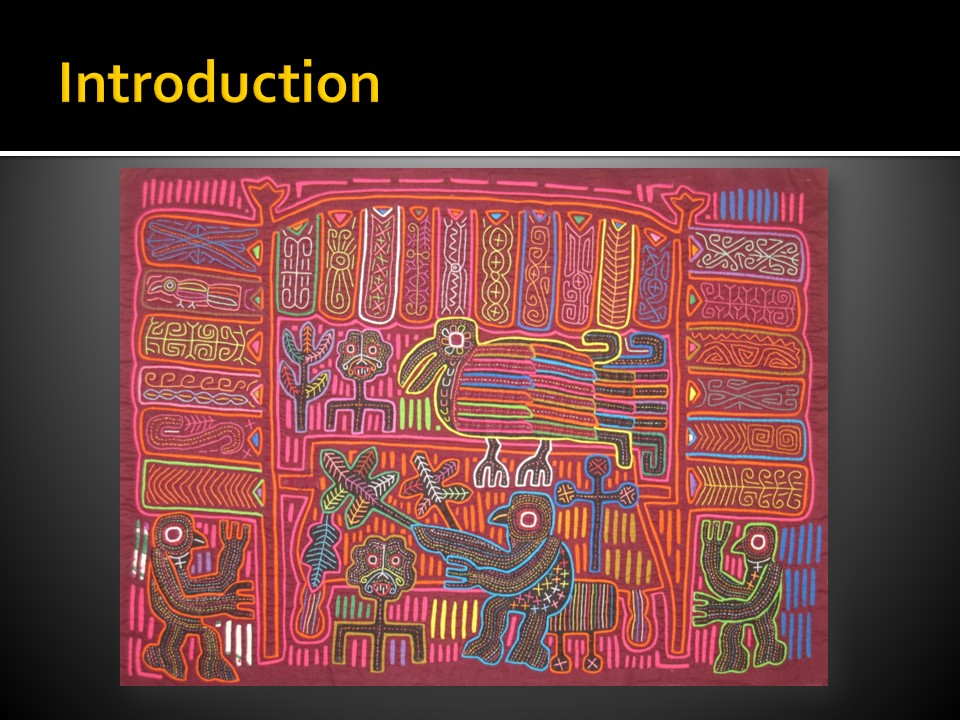
This presentation will trace the development of mola art from the earliest to most contemporary forms including highlights of Kuna culture and history. Molas as a living and vibrant portrait of Kuna life and art will illustrate this story. 
Molas are hand appliquéd textile panels of blouses made and worn by the Kuna women of Panama. Mola art tells a magical tale of the Kuna woman and is emblematic of her culture, artistry, observation, and beliefs. Her cultural cosmology, sense of humor and exposure to foreign elements are represented in her molas. 
The Kuna people live in Panama along the Caribbean sea or Atlantic Ocean in the Comarca de Kuna Yala, Madungandi and Wargandi. Kuna Yala or “Kuna Land” includes a chain of more than 365 coral islands, known as the San Blas Archipelago, and rainforest and coastal mainland stretching to the border of Columbia. 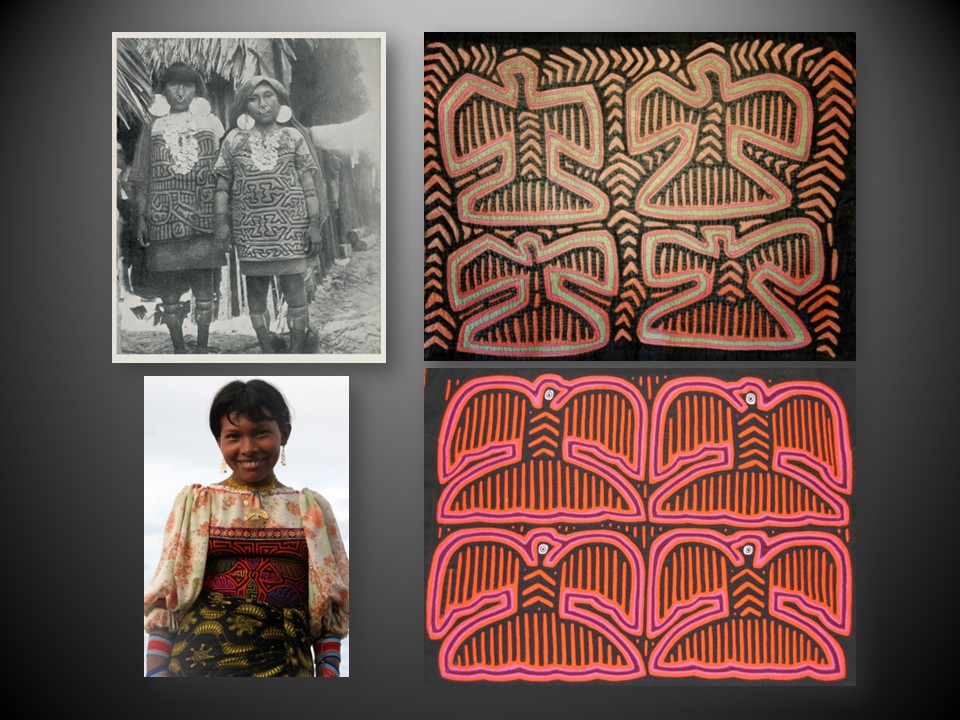
The mola’s history began its development after Spanish colonization. Early mola designs were drawn from body painting and themes from basketry and pottery and in the past century the mola has evolved. 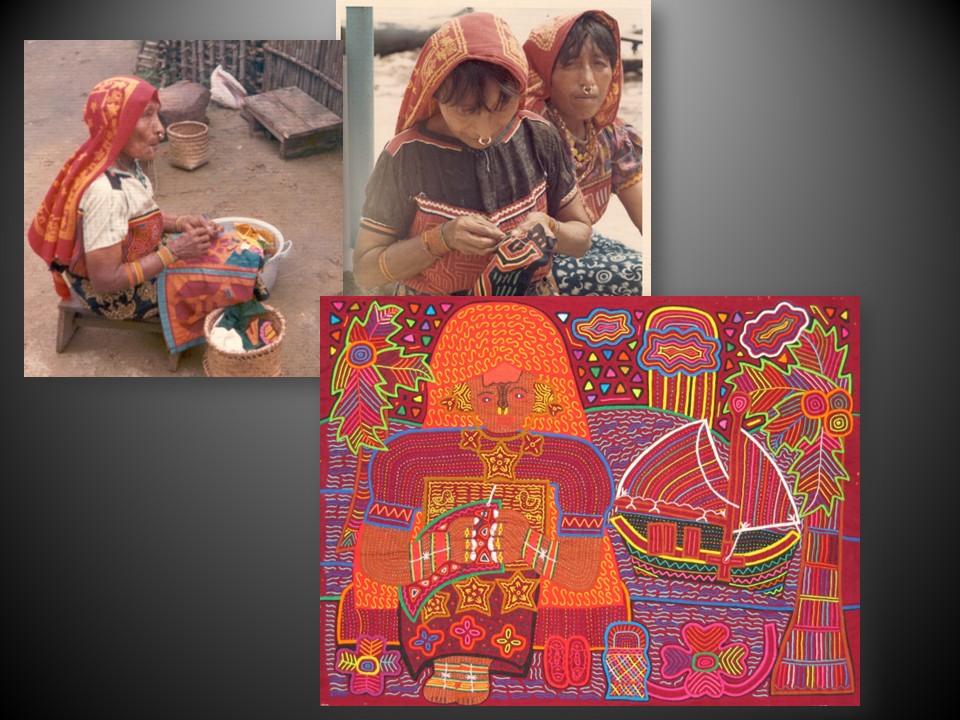
Molas are created in a technique referred to as appliqué or reverse appliqué and consist of two or more layers of cloth. An astonishing variety of design motifs are created by cutting and sewing the colored cloth revealing the layers of fabrics beneath. Many designs and concepts are adapted from historical molas and shared, although each mola is unique. 
The paired mola designs for each blouse are never identical; there is always a design variation. 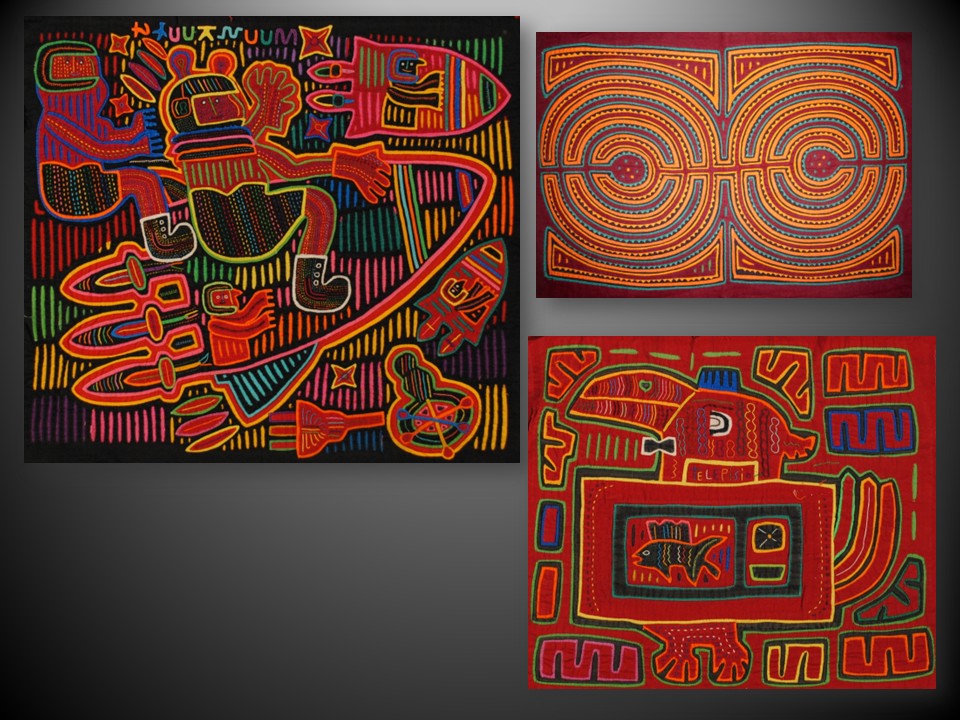
Like so many of you, we grew up looking at the most unusual mola designs – an astronaut riding on a spaceship, or a toucan television. Some molas were geometric designs, like the mola in the upper right – a design of the Kuna woman’s nose ring, which looks remarkable when worn on a mola blouse. Other molas included motifs from the natural world, themes related to politics, popular culture, Kuna legends and lifestyle. 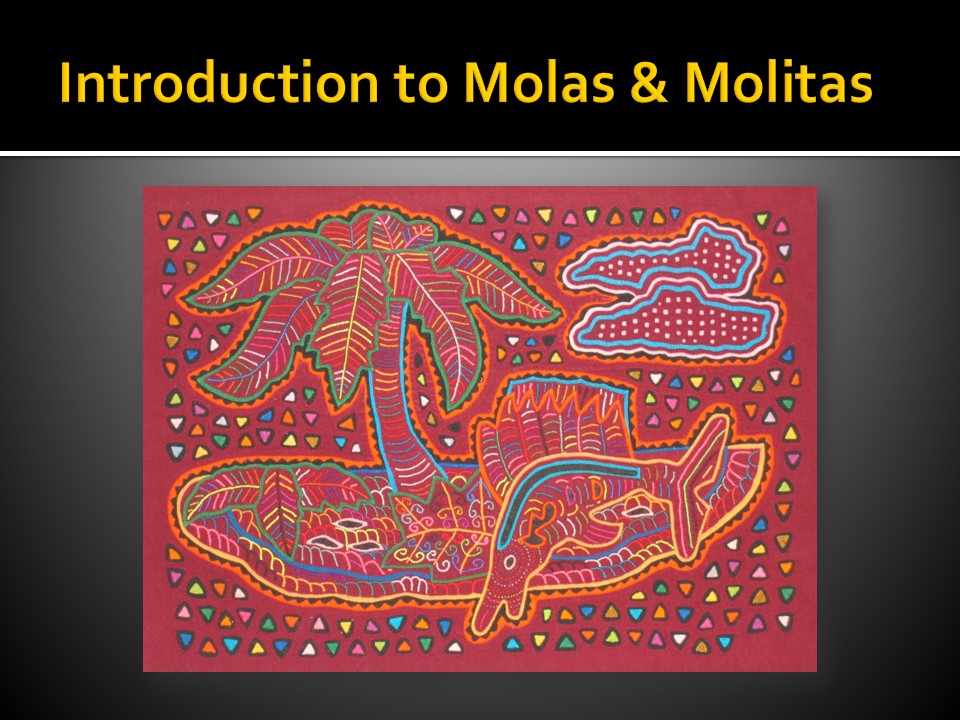
Molas are created using various types of appliqué, including positive, reverse and channel appliqué; embroidery and other stitching methods are also used. 
The mola blouse or “Kuna people’s clothing” is called Tulemola in the Kuna’s language. Fine mola designs, such as this school of fish mola blouse, display subtle asymmetry, parallelism and repetition, with filled space and embellishment 
The earliest molas link the textile art form with Kuna ritual body painting and decoration, described in 1700 as “figural representations of birds, beasts, and trees on every part of the body, painted by the women where their fancies lead them in bright colors of red, yellow and blue.” These two mola blouses are from the 1960s and include a geometric frogs design (top) and an abstract maze or chicken bones design (bottom.) 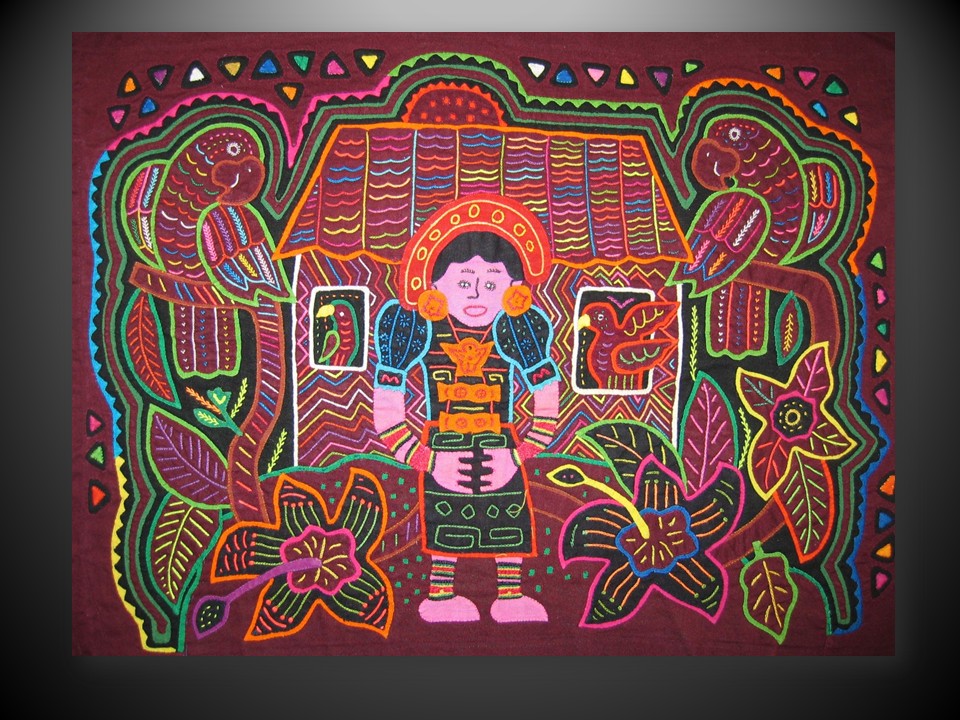
Kuna legends instruct women: “You must have a shawl to hide your loveliness from strangers. Kuna Woman must have golden earrings, and a gold ring to mark her nose and you should wear beads and bells, small shining shells, and cloth woven in all the Kuna colors. Tall ships that dance upon the water are slowly gathering far out on the oceans. Great ships…not like our cayucas.” This belief may account for the early evolution of mola designs from painted body tattoos to clothing. Ritual decorative body painting was practiced by the Kunas until the 1700s when French settlers introduced clothing to the natives. Body adornment was translated into painted designs on tunics and clothing. Trading vessels brought needles, thread, scissors, and factory woven cloth in a variety of colors to the San Blas Islands at the end of the 1800s. The earliest cloth molas were described as short sleeved dark chemises extending to the knees bordered with simplified appliquéd hems, in red and yellow designs. 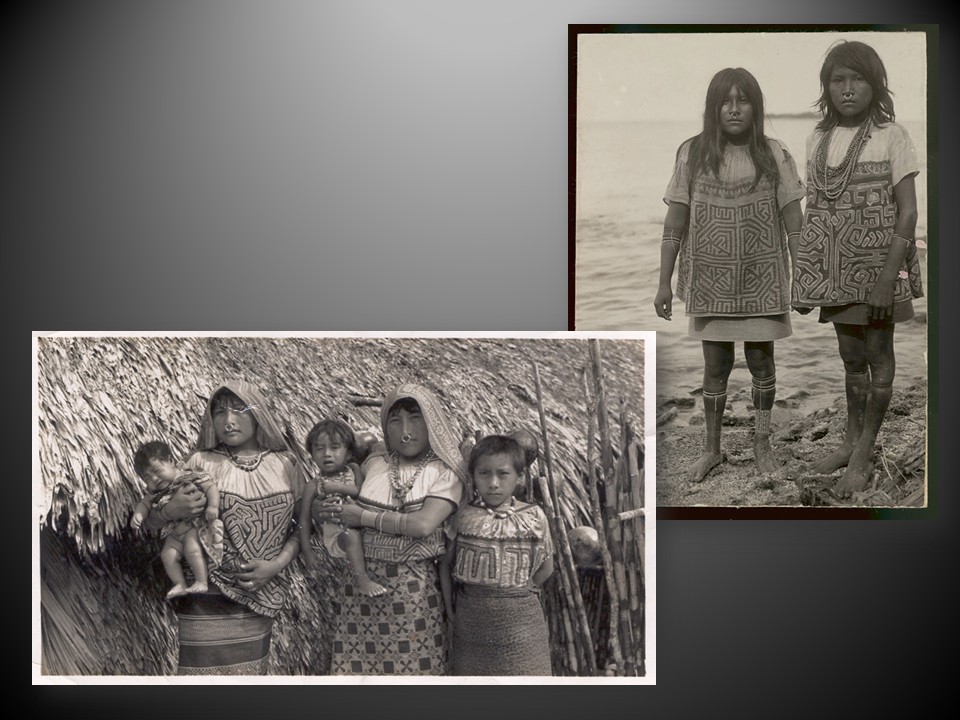
By the 1920’s the mola blouses included decoration over the entire surface with the exception of the yoke and sleeves. These knee-length chemises consisted of two sewn cloth panels, each two layers thick. The edges of the cut out patterns from the top layer of cloth were folded under and sewn onto the bottom layer. The molas of this period were geometric and maze type designs or simplified flora and fauna, with larger stitching and cutwork. During the early 1940s Kuna men working in Panama and the Canal Zone sold a small number of molas and as the San Blas islands became accessible for day tourists and visitors, the mola evolved into a commercial commodity becoming more elaborate, colorful and acculturated. 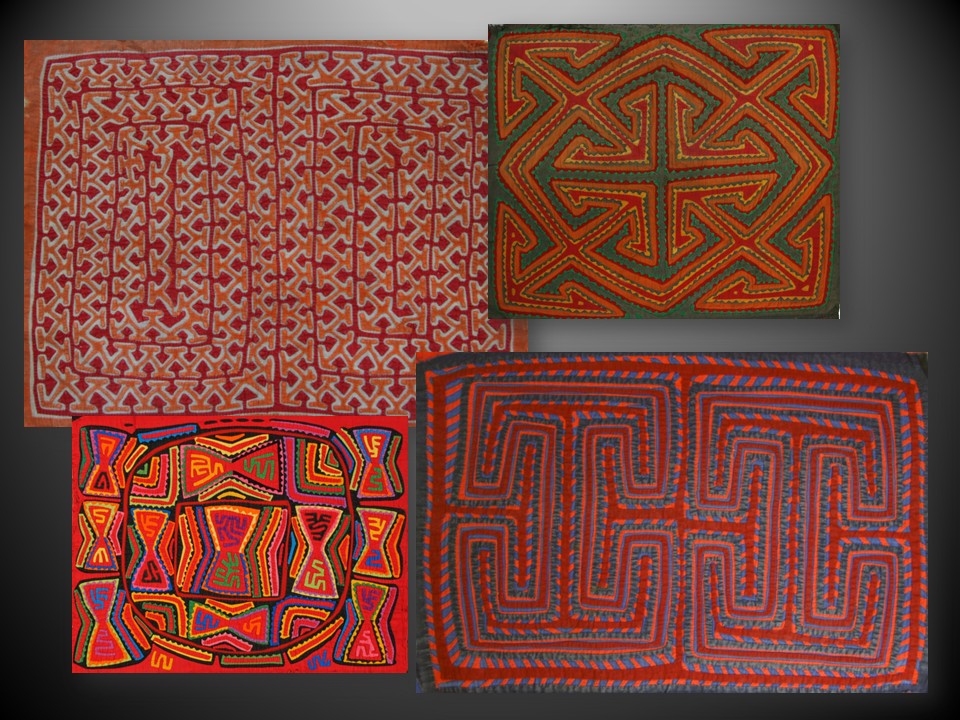
The style, complexity and quality of molas varied greatly in the past, as it does in the present. Early molas often had abstract designs that were inspired by nature or were based on household objects. The mola designs were linear, geometric repeat patterns and have specific names that identify the original source such as Geometric Arrowheads (upper left), Anchors (upper right), Mortars (lower left) and Path of the Hermit Crab (lower right) – when you look at this mola design you can imagine the path that a hermit crab leaves in the sand inspiring an observant artist! 
Molas are uniquely made in Panama by the Kuna. The Kuna women observe the flora and fauna of their tropical environment and sew their interpretations of the beauty that surrounds them into molas. 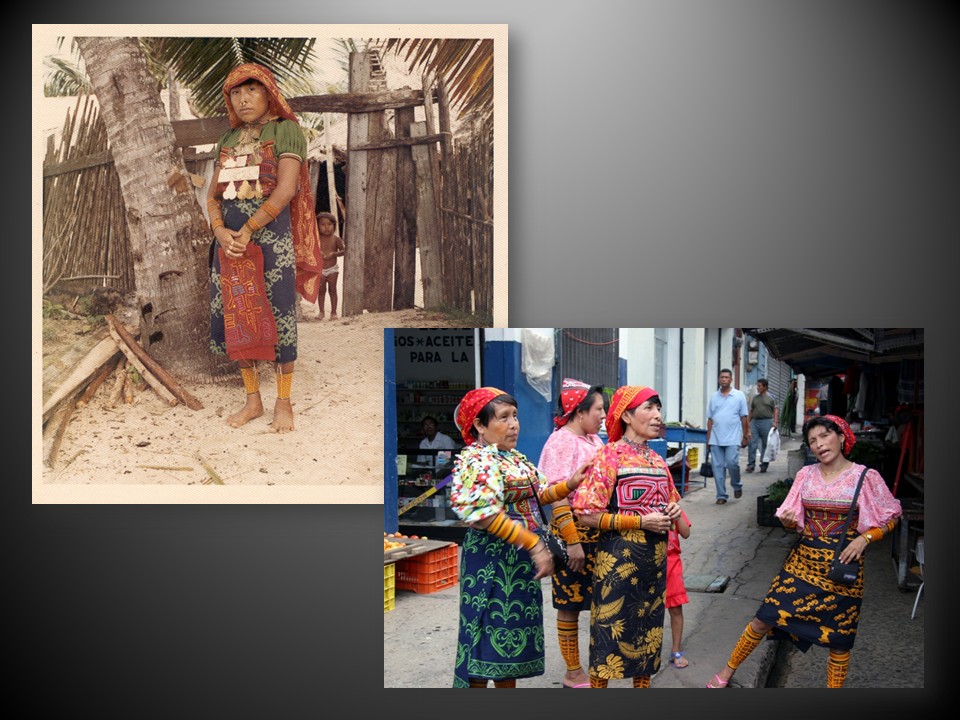
Kuna women dress vibrantly from head to toe, garbed in color and texture. A red and yellow head scarf imprinted with patterned designs covers their glossy dark hair cut short during a “coming of age” ceremony. Their arms and legs are wound with lengths of tiny glass beads, sometimes forming a geometric pattern during the wrapping process. Their nose may be pierced with a gold ring and a thin line painted or tattooed the length of their nose. Strands of shells, beads, bones, shark teeth, coins or other materials are worn as necklaces as are gold and silver pieces and breastplates. Beaded earrings and those made of large flattened gold discs are worn. Their hand sewn mola blouse is tucked into a blue printed cotton sarong skirt. 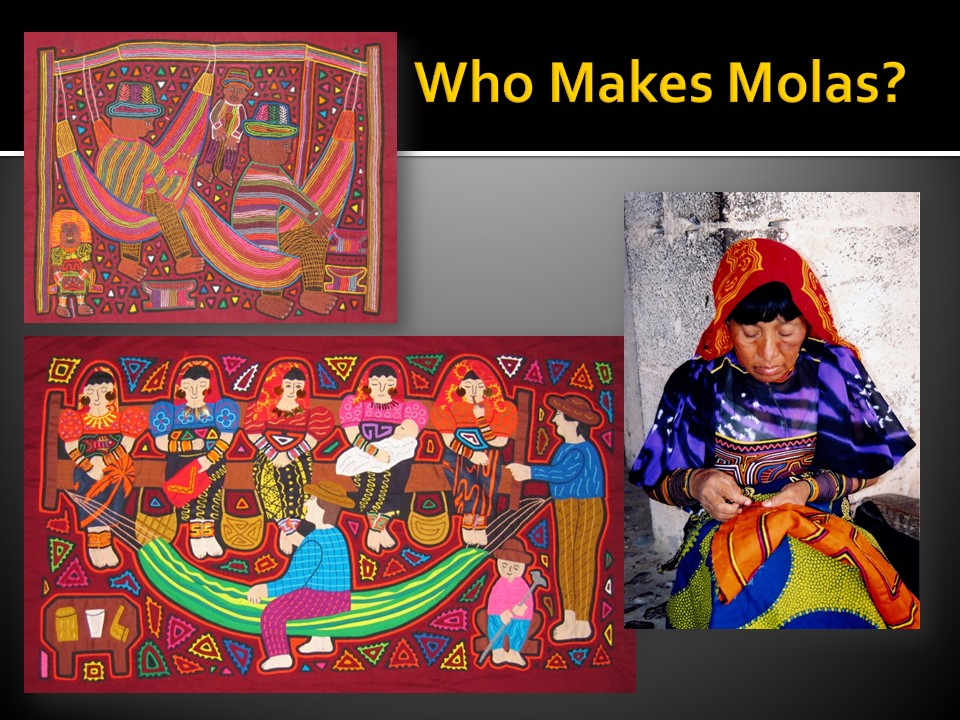
The Kuna women spend much of their day sewing molas independently and in groups. Detailed molas involve over 100 hours of labor over a four to six week period or longer to complete. Groups of women sit together sewing while listening to a saila (chief) chant about the art and history of mola making. 
Girls learn the art of mola sewing by creating miniature molitas at their mother’s and grandmother’s sides, starting to stitch at age four or five. Almost all Kuna women sew molas to wear themselves and to sell – only a few Kuna men sew molas. Some mola artists display a greater talent or aptitude with an appreciation of one another’s work that is shared, as are mola design resources. 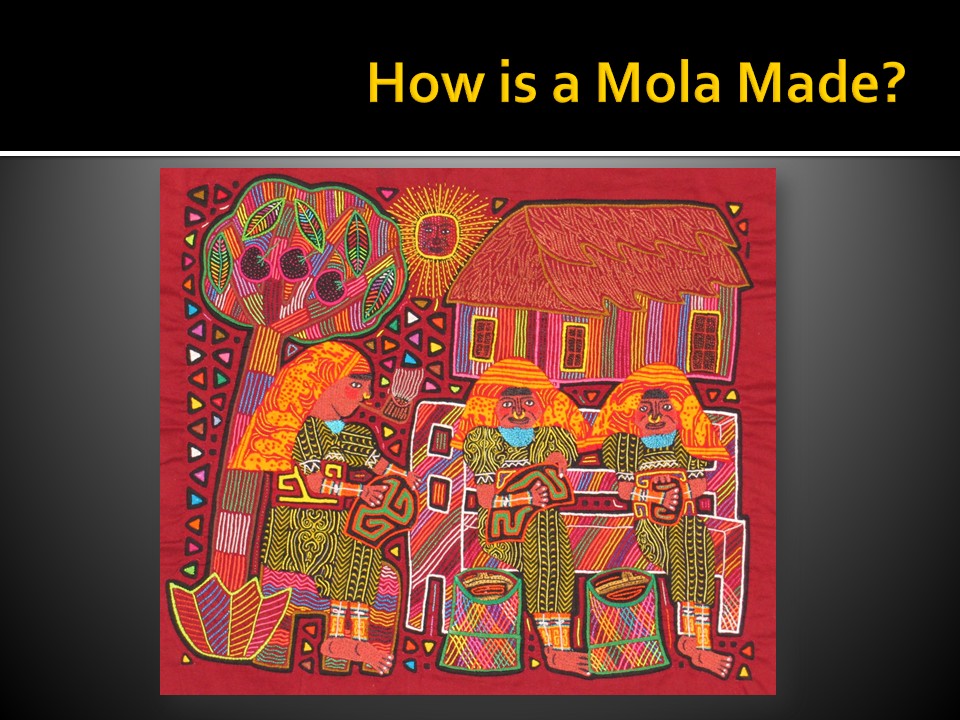
Molas are considered to be appliquéd in that layers of cloth with designs cut into them are “applied” to a base layer. Each mola panel has two to seven layers of colored cloth that are initially basted together. Mola designs are usually sketched out with pencil on the top layer of fabric and then cut out across layer by layer, revealing the colored cloth beneath. The cut edges are turned or tucked under and hemmed to the next layer of cloth, concealing the thousands of tiny stitches. Additional decorative topstitching or embroidery are features in mola creation more common today than a few decades ago. 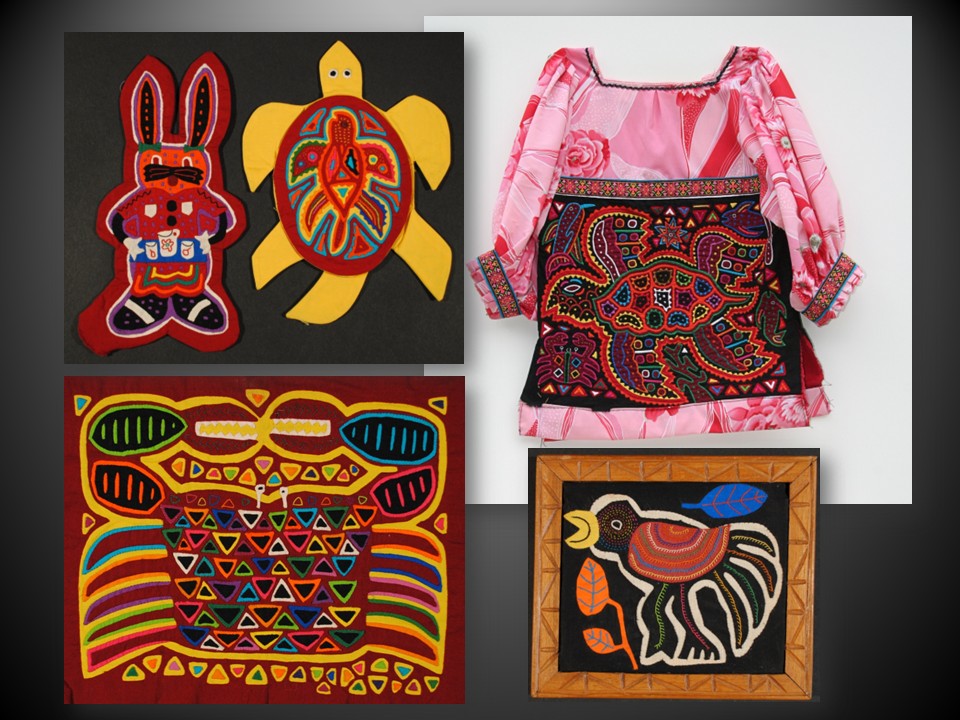
The development of the tourist industry, the increased interest in indigenous crafts and the commercialization of molas in the 1960s resulted in molas becoming widely available and sold. Today, molas are sold as single art panels, as a pair or by the entire blouse. Molas and molitas are used in the making many of gift items and contemporary clothing. Molas have also been customized with medical, legal or other themes, sometimes incorporating a company’s or person’s name. 
Some molas are designed not to be worn, but instead for the tourist trade. However, they still may be beautifully conceived and created, such as this marine coral reef scene. 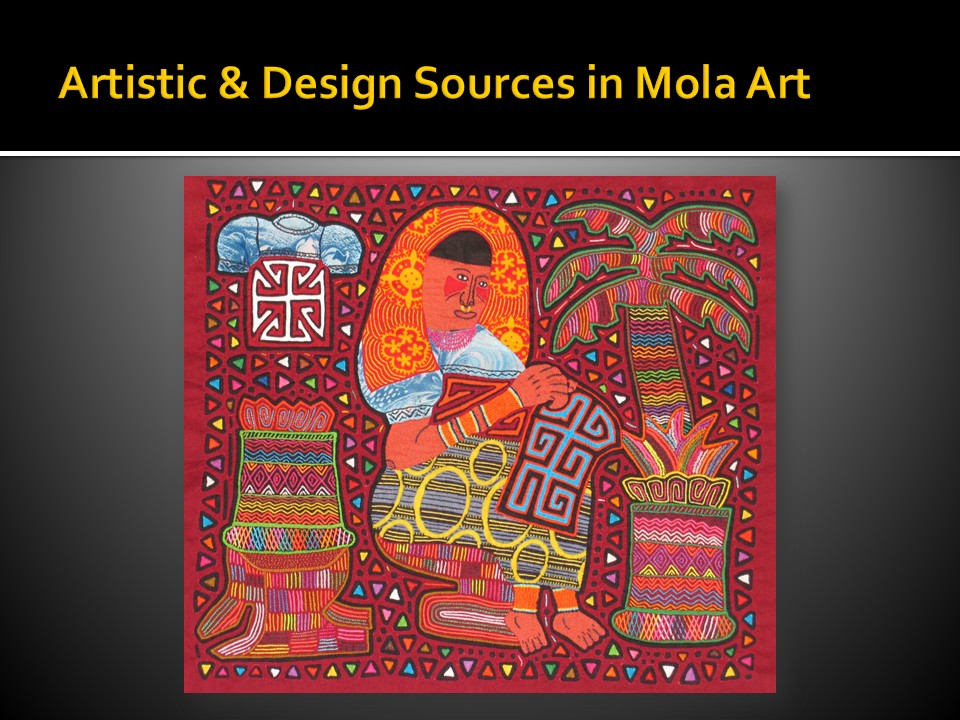
Mola designs may provide a window with a view of Kuna history and traditions. Kuna women reference scenes from their lives and personal experiences and the broader world surrounding them for their highly imaginative mola design ideas. 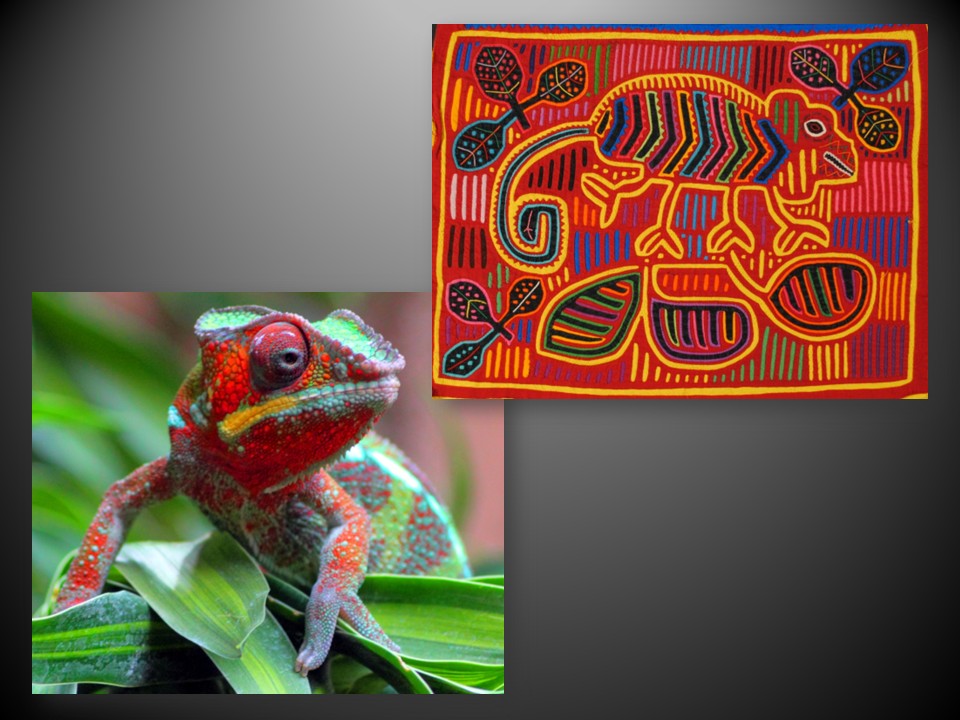
The design motifs are varied: they may be zoological, such as this colorful native chameleon mola from the 1960s… 
…or reptilian, such as these textured and detailed iguanas molas, the front and back of a mola blouse from the 1960s… 
…or of tropical birds, such as this contemporary toucan mola… 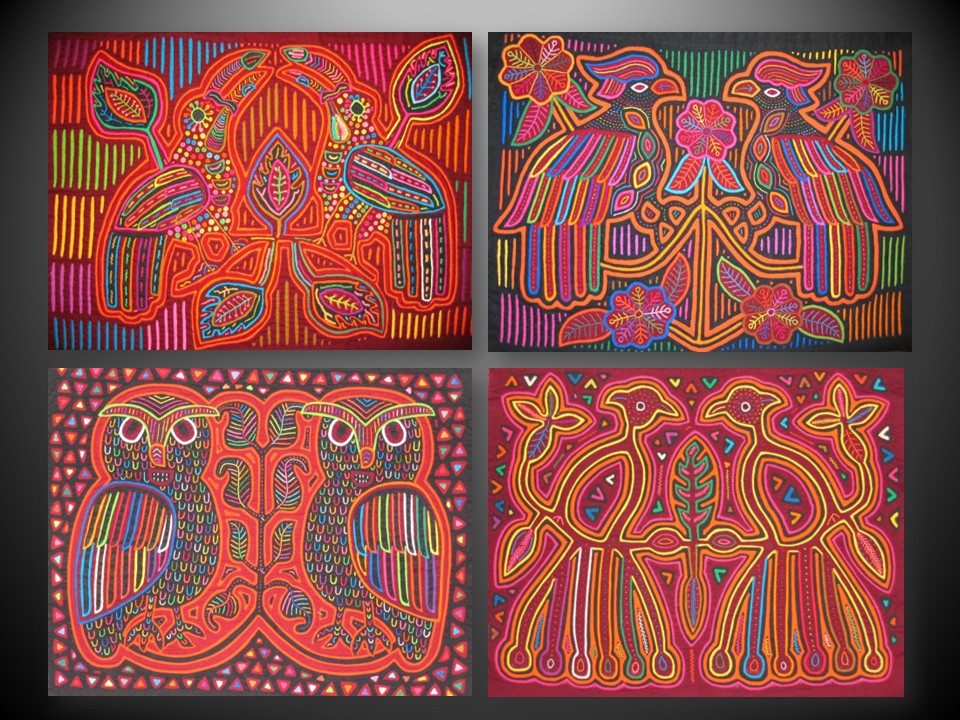
…and this colorful assortment of pairs of birds of many feathers… 
…or these hummingbirds sipping nectar from a flower…or this beautiful bird with wings unfurled surrounded by tropical plants. 
Designs may be inspired by local trees, such as this coconut palm… 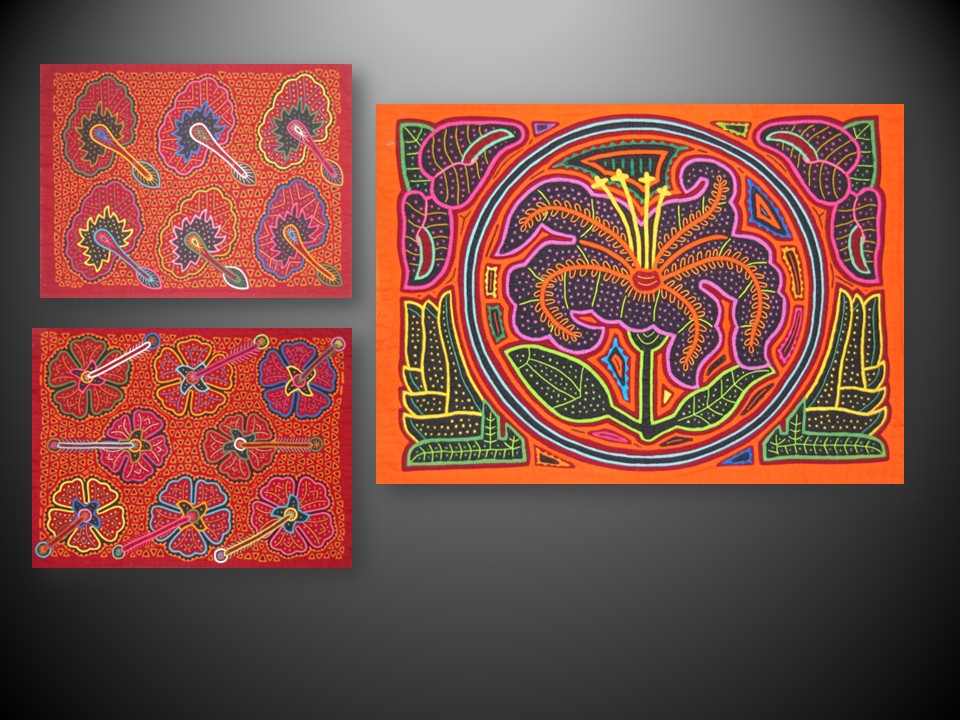
…or tropical flowers, such as the hibiscus… 
…or this variety of leaves of many colors and shapes… 
…and local tropical fruits and vegetables, sometimes portrayed from various perspectives. 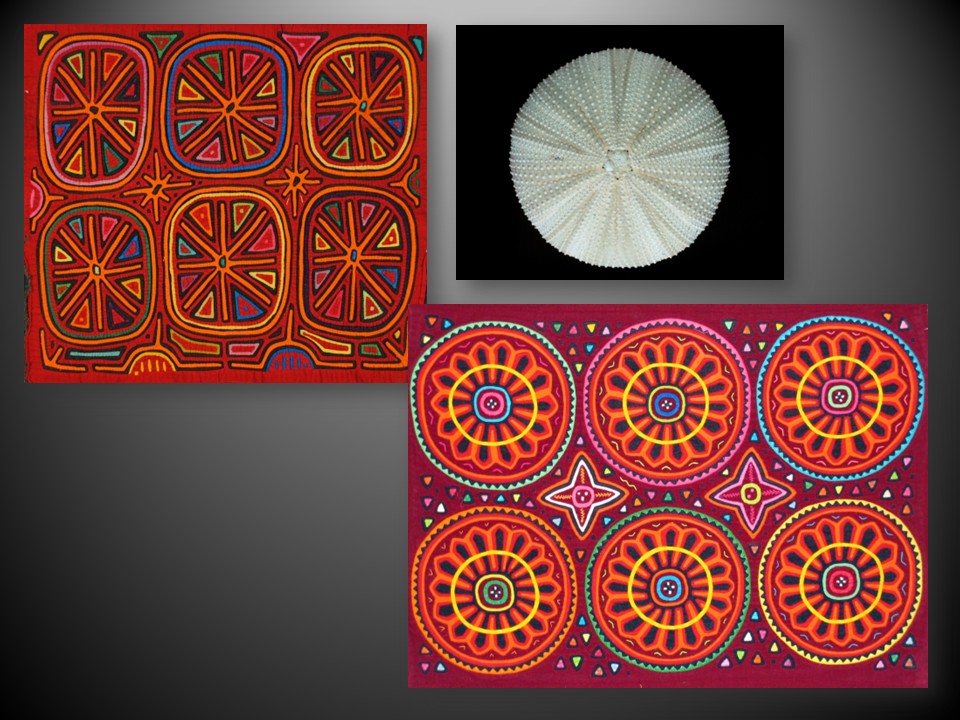
Designs may be inspired by other elements from the Kuna’s environment such as these sea urchin molas (the upper left mola is from the 1960s and the bottom right mola is contemporary)… 
…or from sea life, such as this turtle (tortuga.) 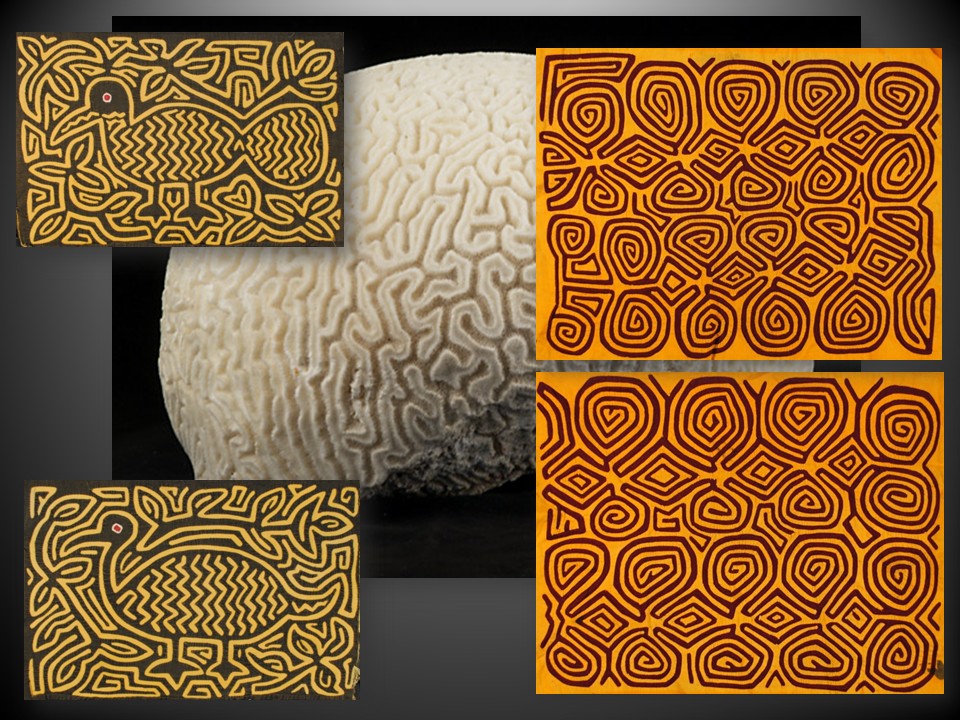
Geometric, abstract and labyrinth designs depicting meandering mazes may have their source in similar surface linear patterns of the brain coral found in the seas of the San Blas archipelago. 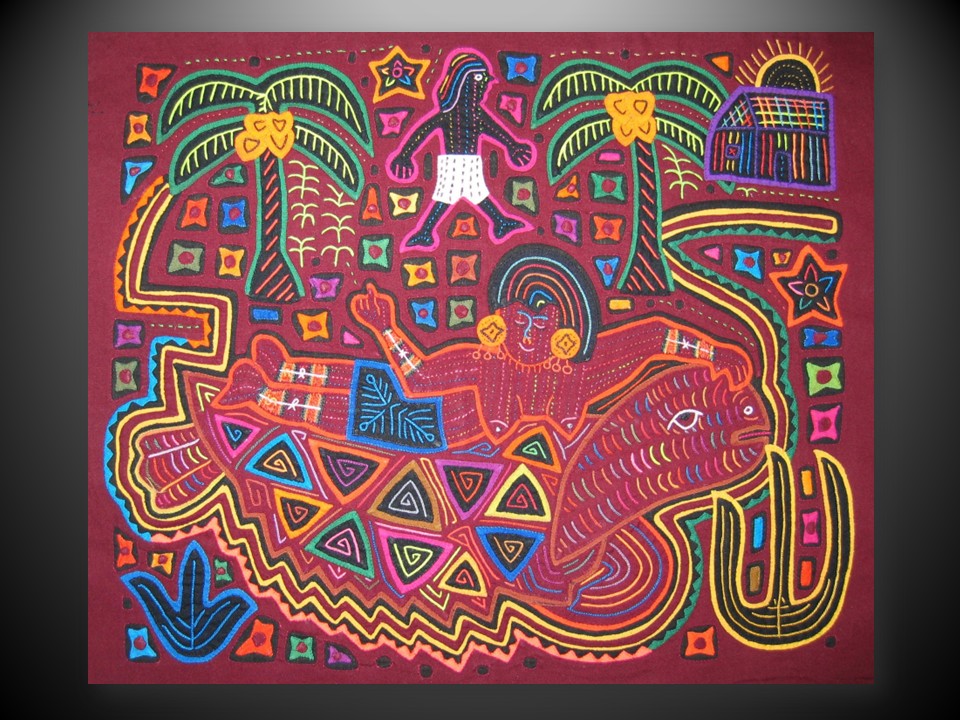
Kuna legends, folklore and myths are represented in mola designs. 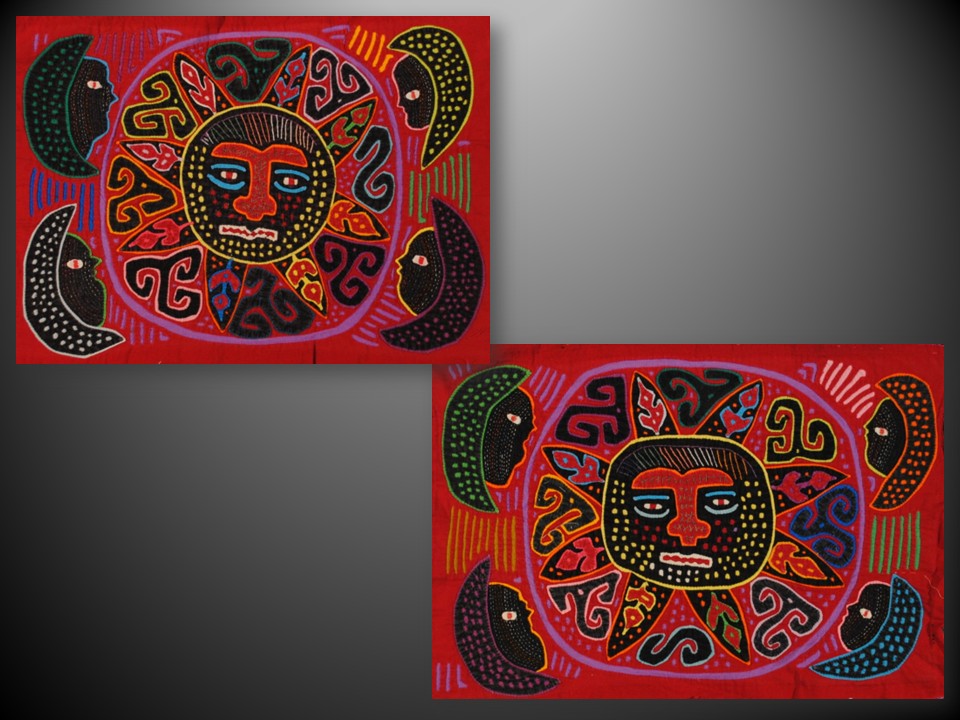
Celestial themes, solar eclipses, earthquakes and other planetary and universal motifs are depicted. 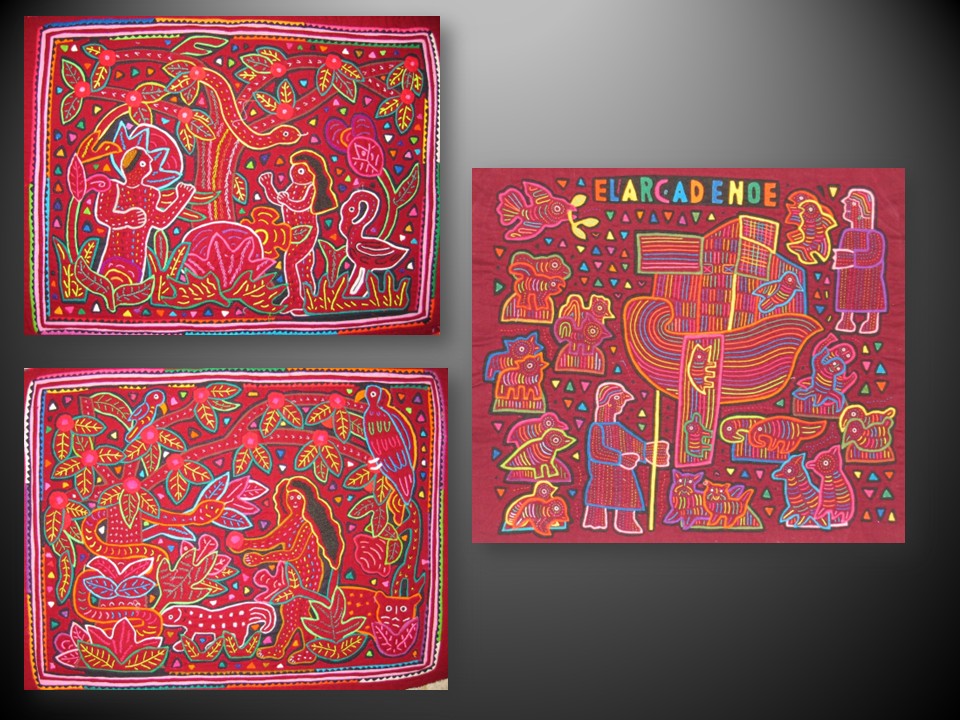
Religious stories are told such as “The Garden of Eden” and “Noah’s Ark” with native flora and fauna included in the mola designs. 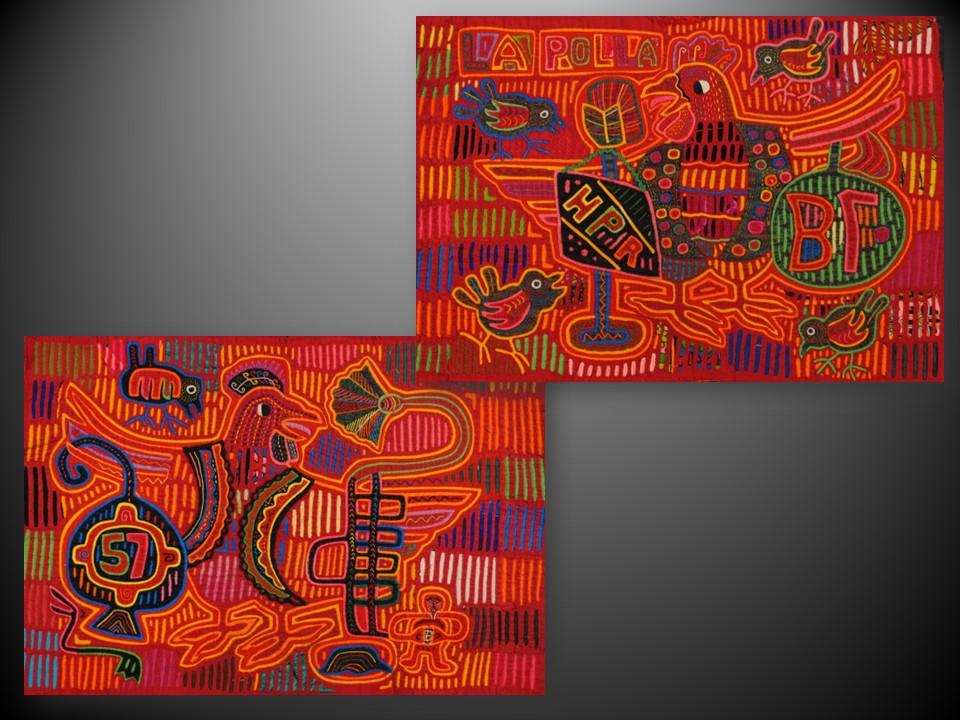
Religious stories are told such as “The Garden of Eden” and “Noah’s Ark” with native flora and fauna included in the mola designs. 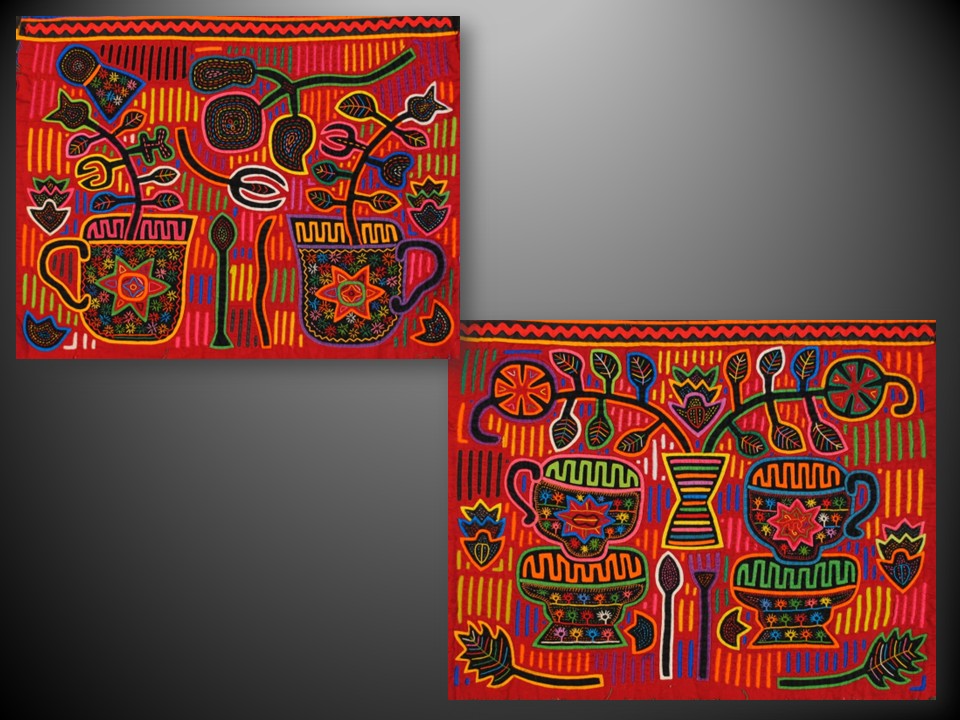
These vintage mola designs of place settings come alive with tropical plants and anthropomorphic tea cups. 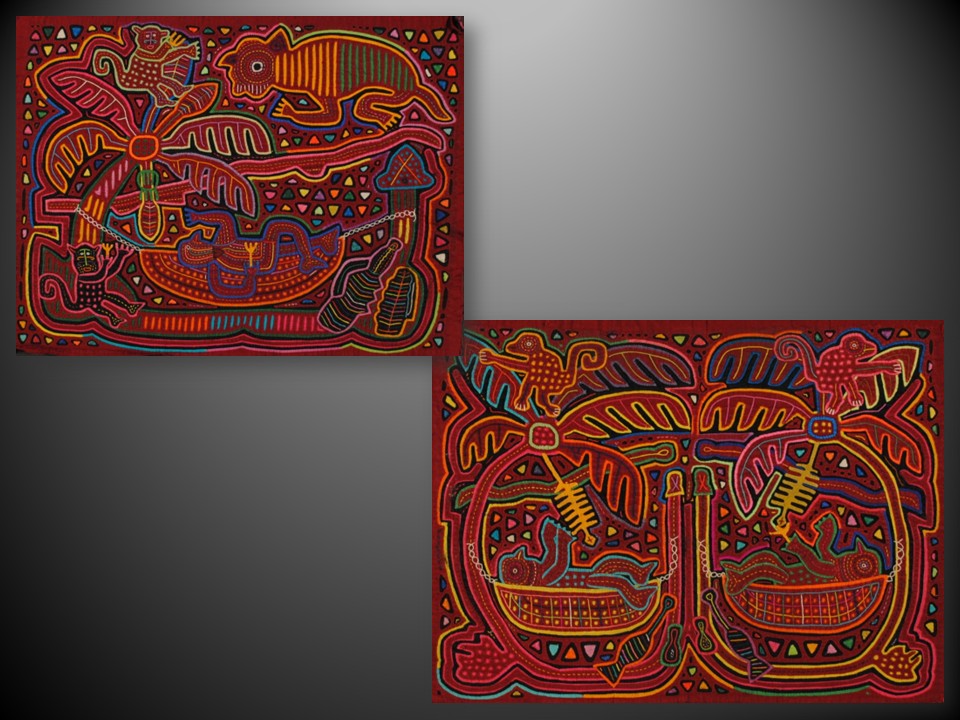
Molas may depict details of the Kuna’s life, such as these reclining and relaxing figures in hammocks surrounded by monkeys in banana trees and an agouti. 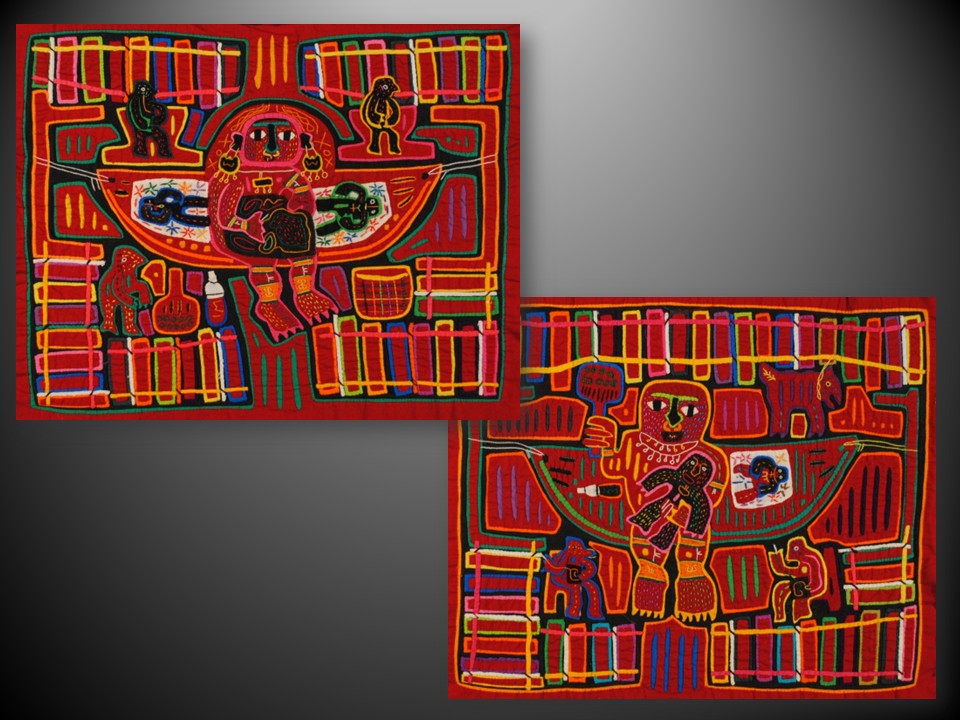
These companion molas from the 1960s depict women caring for children inside their homes with the wooden slats of their houses creating the mola’s border designs. 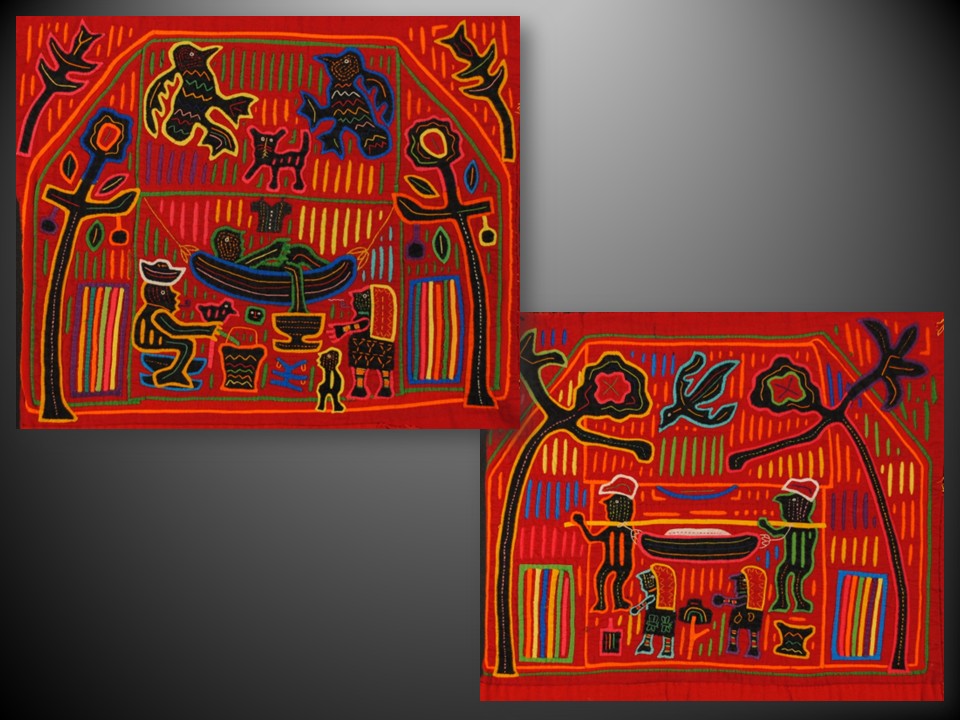
In these vintage molas a patient is attended to by a medicine man and then the deceased Kuna’s shroud is carried out for burial. 
In this traditional mola design a “keeper of braziers” wears a feather hat and necktie indicating that he is an official while holding two ceramic braziers used for burning cocoa bean incense in ceremonies. The bottom mola depicts Kuna men playing panpipes and women shaking gourd rattles that accompany ceremonial chanting and singing. 
A comparison of vintage and contemporary molas reveals a creative path this art form has travelled. These are two molas depicting armadillos – the one on the left is from the 1960s and the one on the right is contemporary. 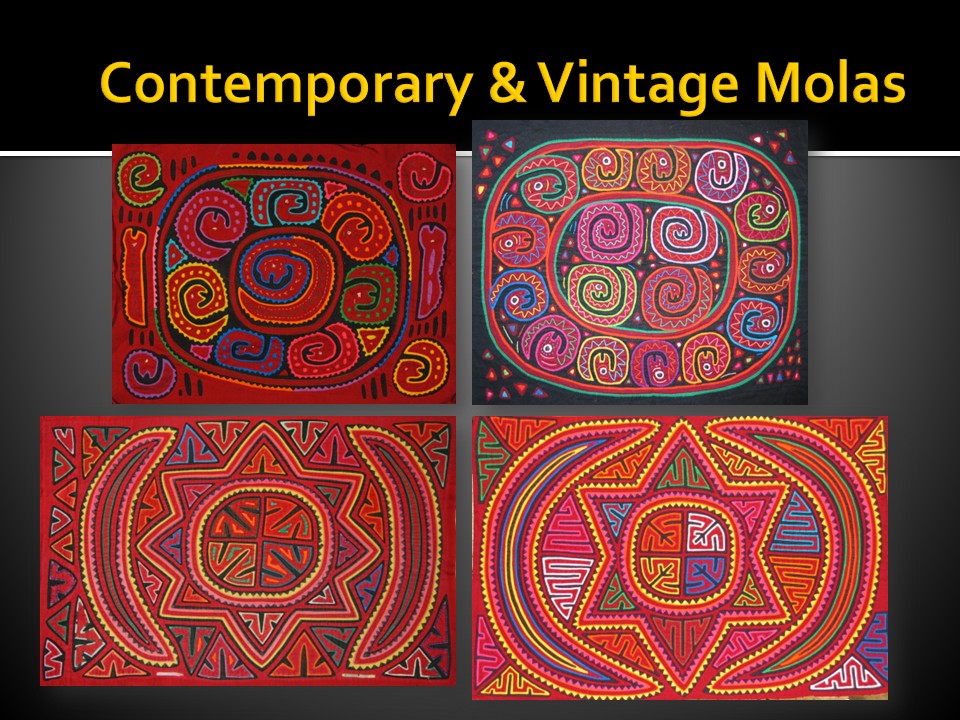
Many modern Kuna artists have mastered the art of mola making creating innovative and elaborately designed and sewn molas that have built upon their mother’s and grandmother’s artistic foundation. Old designs (such as these on the left) are updated with added elements and new color combinations (on the right.) 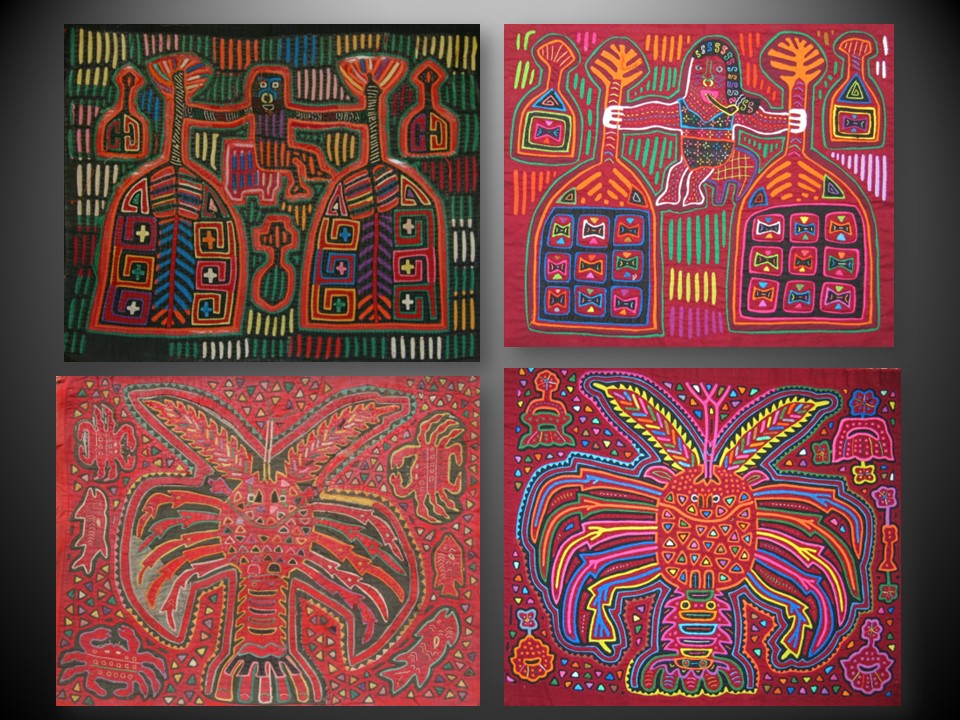
Many modern Kuna artists have mastered the art of mola making creating innovative and elaborately designed and sewn molas that have built upon their mother’s and grandmother’s artistic foundation. Old designs (such as these on the left) are updated with added elements and new color combinations (on the right.) 
Turtles have been a popular design motif for generations and are seen here in many styles. 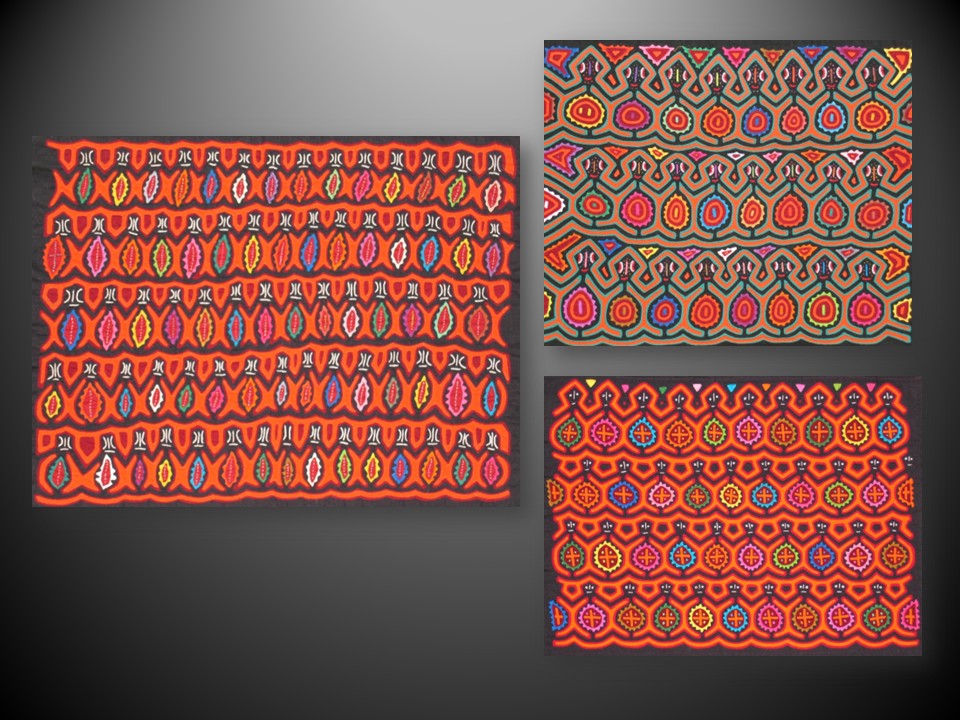
Some mola designs include a repeat pattern of women, turtles or frogs. 
The cartographer, Captain Kit S. Kapp sailed throughout Kuna Yala in the 1960’s creating maps of the region and collecting over 5000 molas from the first half of the last century. He classified the mola designs into the following categories: (Twin Stars) 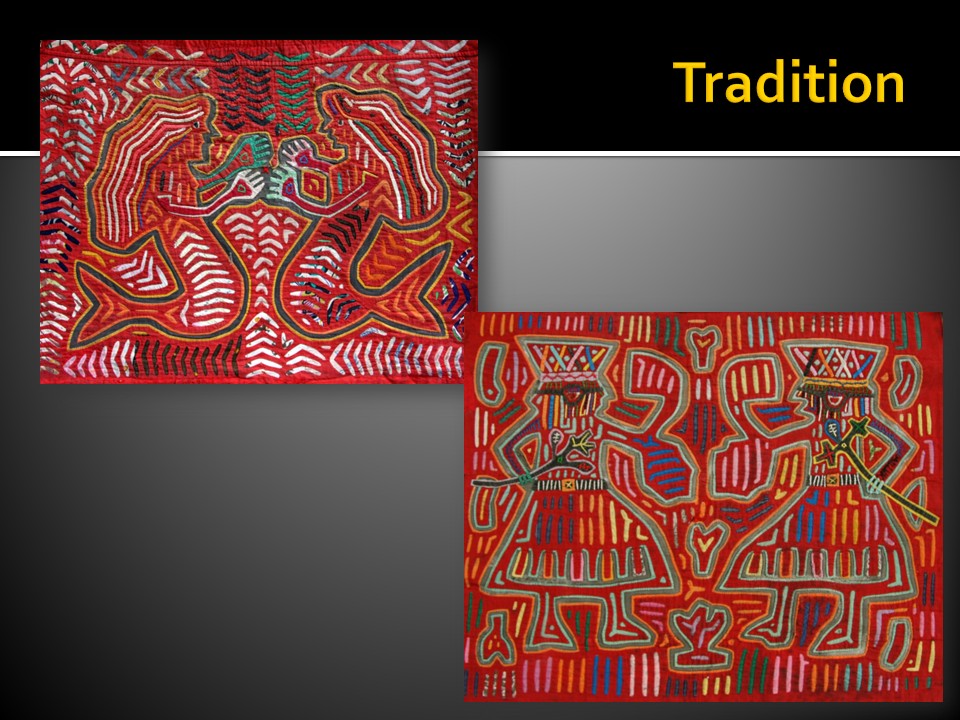
TRADITION molas included themes of Religion, Superstition and Mythology, Tribal Objects, Dominant Persons and Native Scenes. (Mermaids mola, top, and Singing Cantors or Kantule, bottom.) 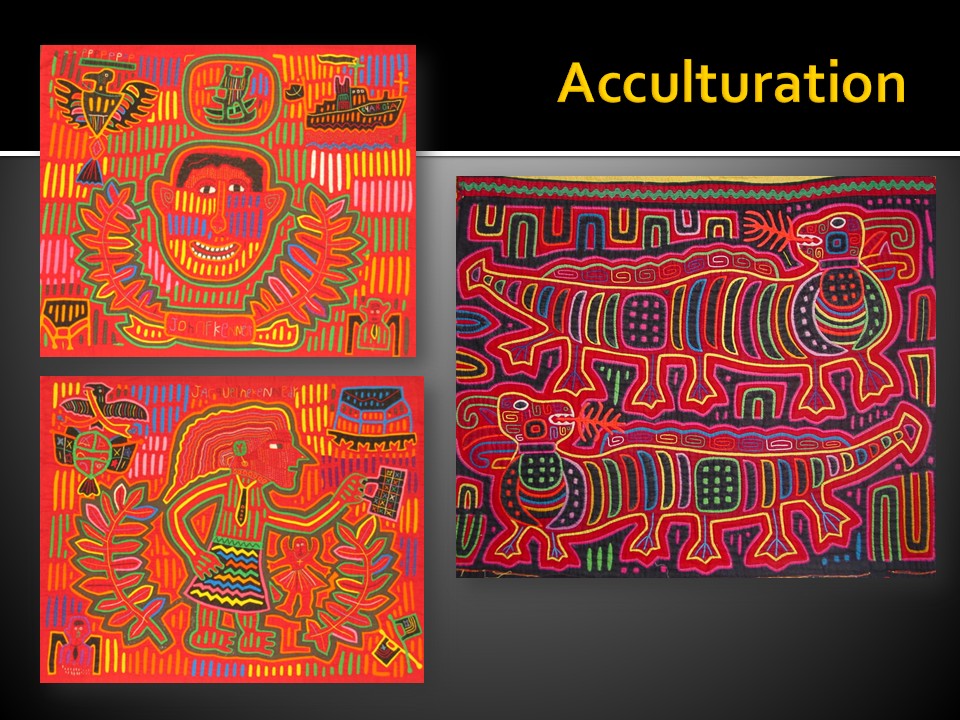
ACCULTURATION & WESTERN INFLUENCE molas included themes of Christianity, Objects & Symbols, Western Literature, Political and Special Events. The molas on the left depict popular political figures from the 1960s – John F Kennedy and Jacqueline Kennedy. JFK is surrounded by laurel wreaths, an eagle, his rocking chair and the PT 109 boat. First Lady is depicted in stylish attire with their young daughter Caroline by her side. The mola on the right is a Chinese dragon floats mola – floats such as these were included in the Carnival parades held annually in Panama City, Penonome and Los Santos. 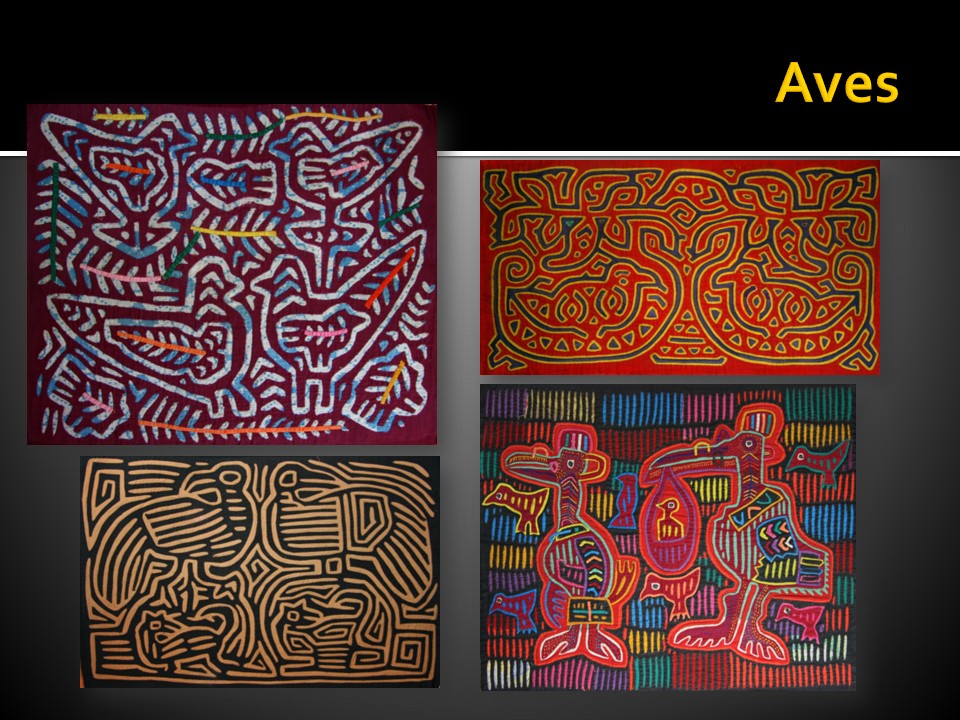
AVES or bird molas included tropical birds, birds in cages, mating birds and storks delivering baby birds. 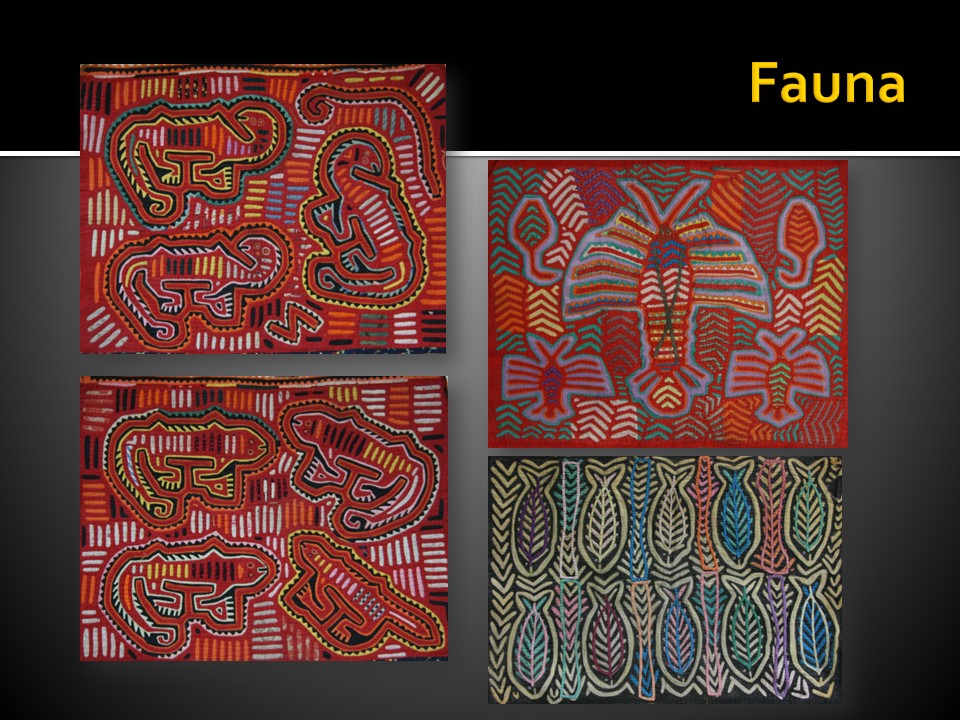
FAUNA molas included Mammalia, Reptiles, Insects and Aquatic themes. 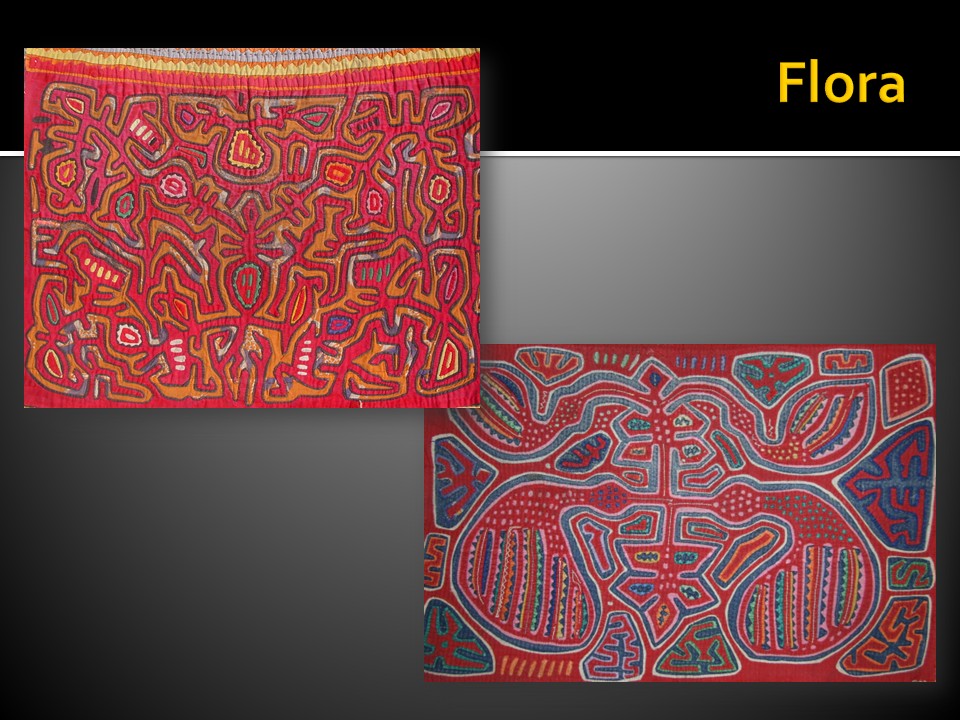
Floral molas included abstract and geometric flowers, trees, tropical fruits and vegetables and misc. plants. 
Geometric and abstract mola designs included representational and linear abstracts, numbers and letters. The top left mola is a Frogs design and the bottom left is a butterfly mola. The Swastika mola on the right is a favorite Kuna design often used in basket weaving and dating back to the 1920s when a blue swastika, representing life and power, was chosen as a symbol for the Kuna federation, the Republic of Tule. 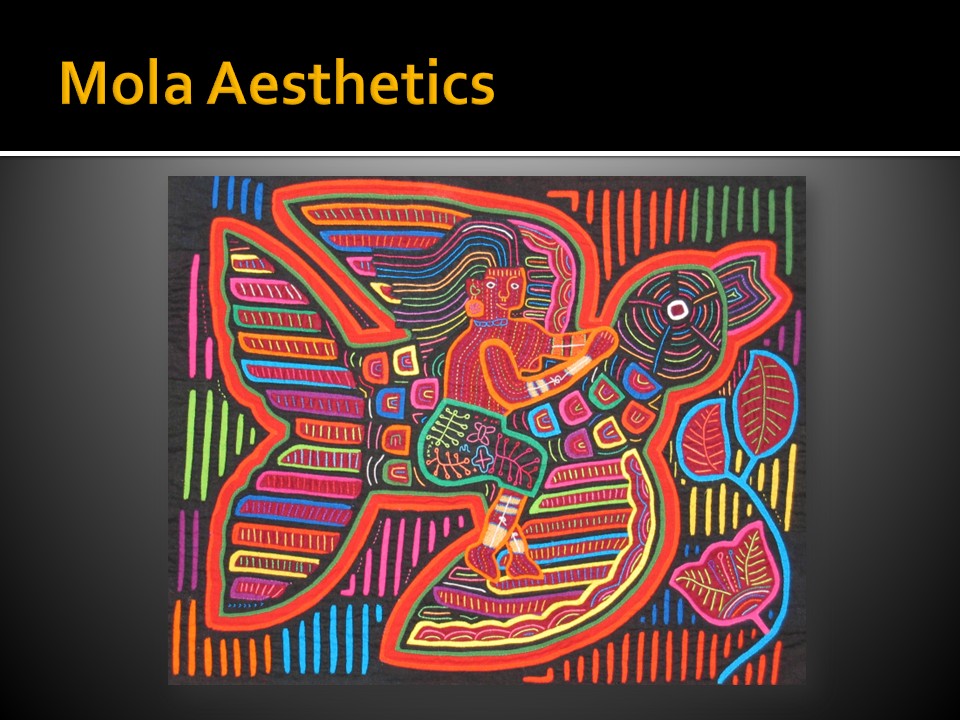
Mor Yer Dailege A Beautiful Mola is appreciated for its vibrancy and design. 
The artistic quality of a mola may be seen in its intricate design and workmanship… 
…and the creative use of color, balance and detail. 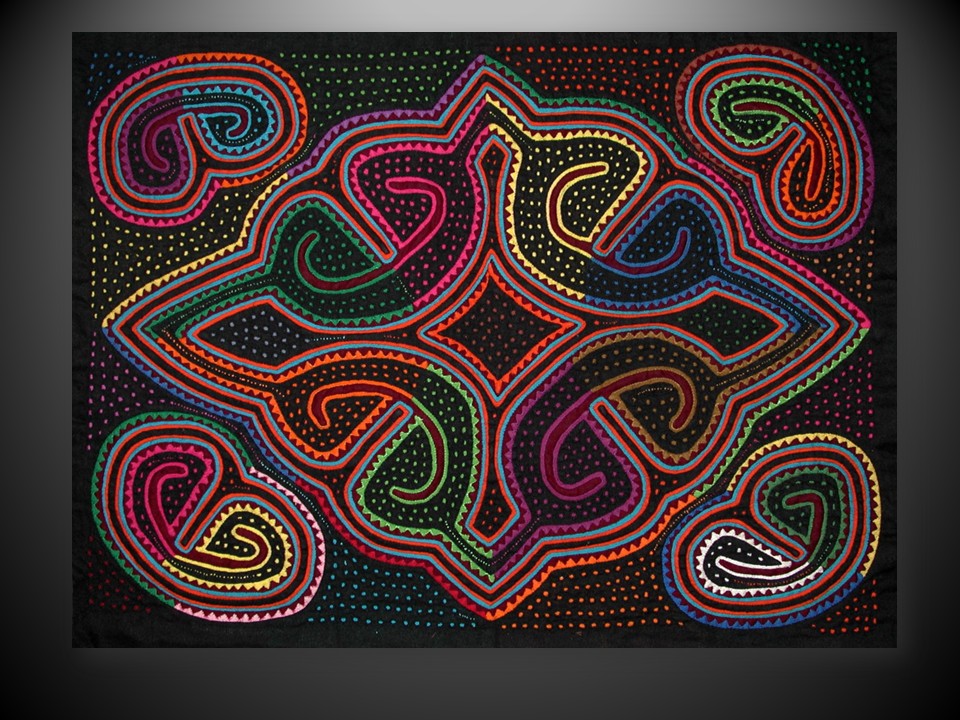
Kuna criteria for fine-quality molas is based on craftsmanship, balancing of design elements, the subject matter portrayed, and color combinations. This mola includes dientes, or sawtooth borders drawing attention to the design elements. Small circular motifs, called gwini gwini are used as background space fillers. 
A mola is visually organized by balancing design elements in the foreground and by filling spaces between in a unified background pattern. Subtle asymmetry in design may be found in the pattern shapes, outline colors or in the filler background details. Background filler motifs may include a repetition and variation of geometric designs, slits or slots, triangles, dots, circles or other elements. An integrated design with connected geometric patterning in foreground and background (bisu-bisu) adds depth to a design. 
Short parallel slits or slots called das das are made in the top layer and stitched open to expose small patches of colored cloth, which have been placed between the two layers. 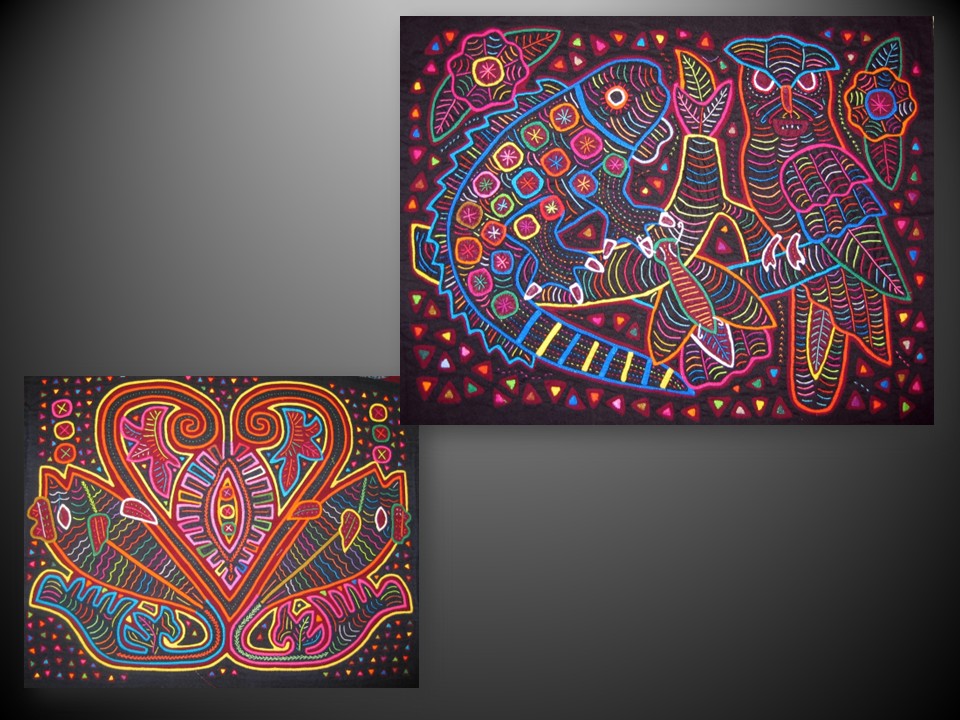
The inset triangles (wawanaled) seen in these molas require patience and skill…(the upper right mola shows an iguana and owl sharing a branch in a nocturnal scene with twinkling star like wawanaled triangles – in the bottom left mola of two fish, the wawanaled triangles create an effect of colorful bubbles.) 
These companion molas are related yet distinct aquatic designs with similar motif elements and color combinations. 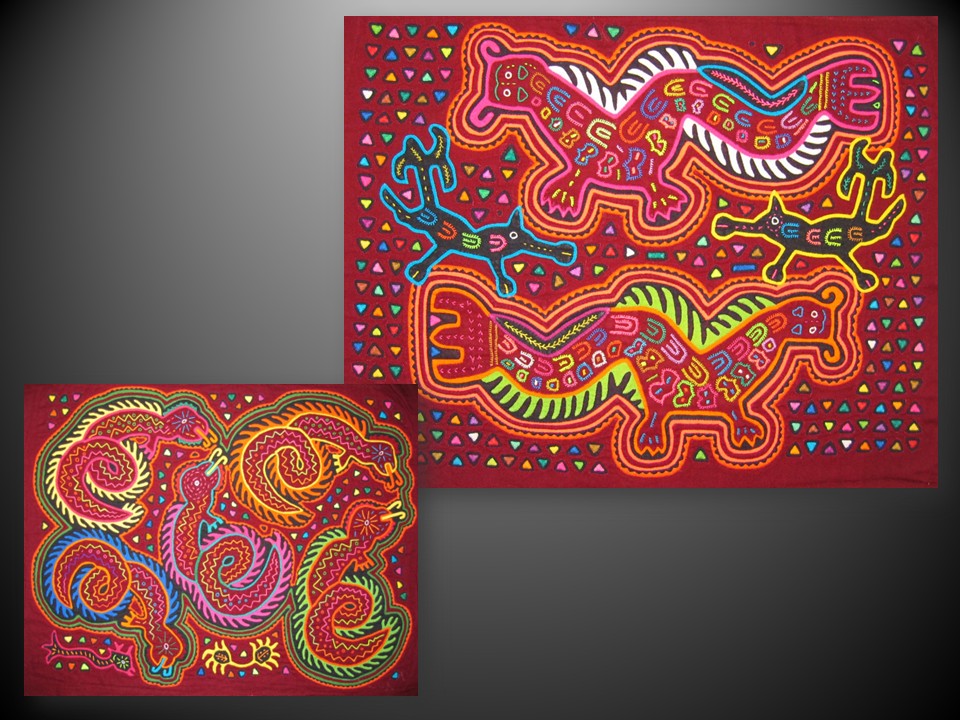
Excellent mola craftsmanship includes: using fine cloth and thread, the careful cutting of the design elements; sewing curves with smooth edges and outline strips uniform in width; creating fine background details; using decorative stitching and embroidery to emphasize detail yet retaining use of cut-outs and reverse appliqué techniques. 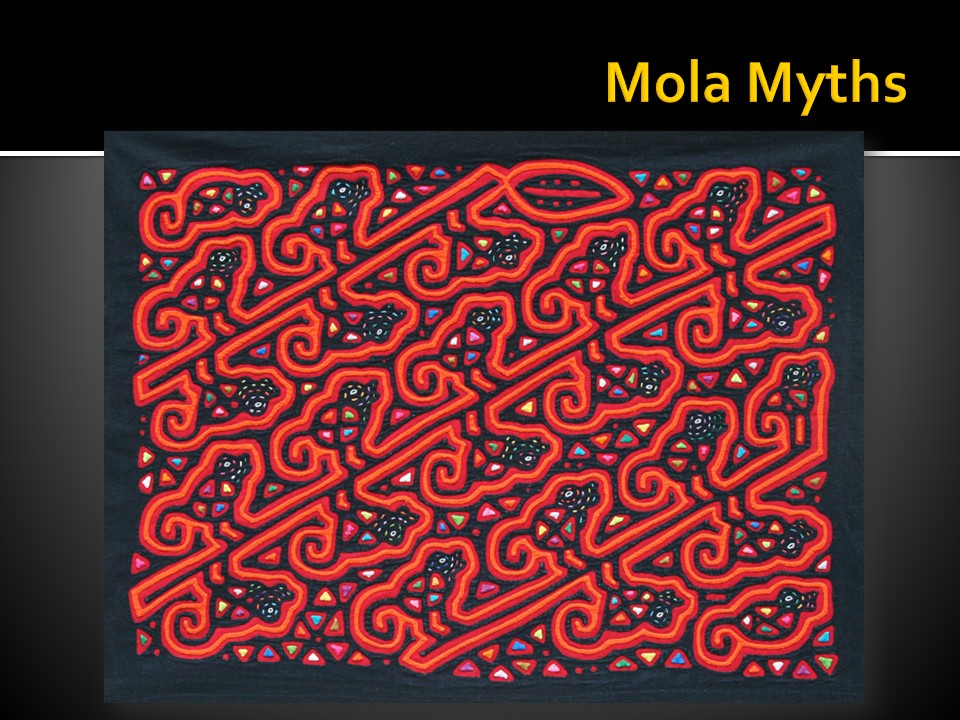
There are several mola myths that should be dispelled: Myth: The only good molas are the old molas. Truth: Old molas have historical value but many contemporary molas are beautifully made and collectible. Myth: They just aren’t making molas as good today. The art is dying. Truth: Some molas made today are more intricate and detailed than ever. 
Reviews of the first mola exhibits in the 1960s established the artistic merit of molas. One review stated that: “These elaborately designed and painstakingly executed cloth panels are brilliant artifacts at the very least, or at a higher level are folk art of a superior kind and are very often works of fine art in a living form. No other folk art in the world, is so inventive and every ‘mola’, differing however much in imagination and workmanship, is a personal statement.” Molas are appreciated as unique works of art and have interested collectors and inspired textile artists globally with their engaging designs, brilliant hues, and fine stitching. 
The Kuna people have retained their societal identity and traditions and lead a balanced and autonomous life, free from many of the complexities of some societies. 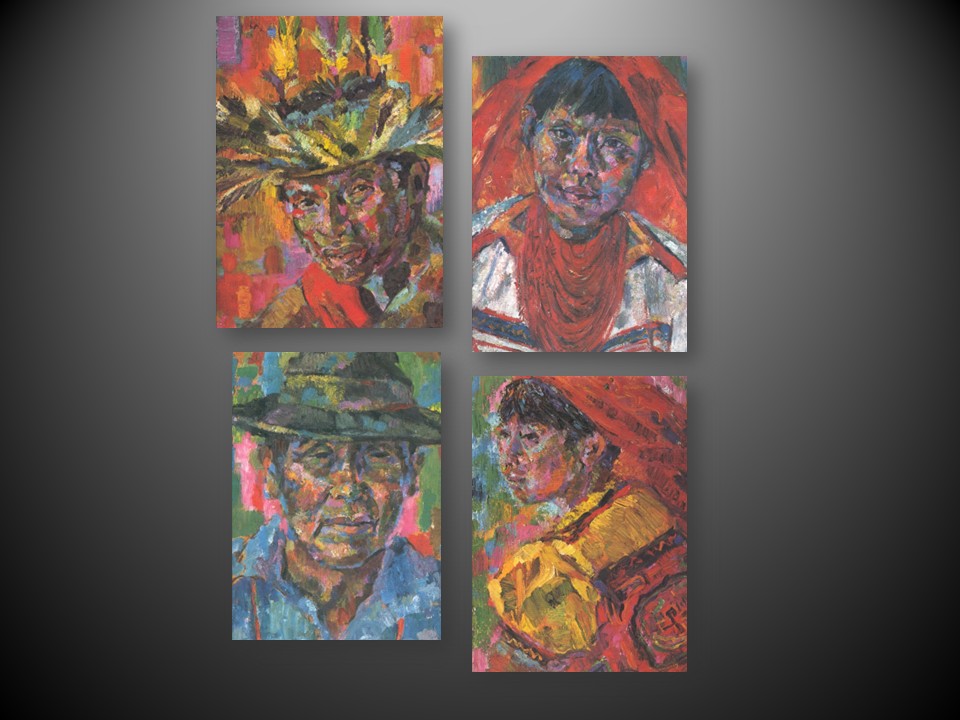
These four paintings from the 1960s by the artist Texana, depict the Kuna people in vibrant colors reminiscent of mola color palettes. Their titles are: “Cuna from Achutupu wearing a Kantule bonnet” ; “Child of the Cunas”, “The Medicine Man”, and “Daughter of the Medicine Man.” The word “Kuna” means “the Golden People” – as the Golden People the Kuna have maintained their tribal and cultural identity these many hundreds of years. 
In the early 1500s, when Balboa built the first European settlement in the New World along Panama’s Caribbean coast, the area was inhabited by the Kuna. In the late 1600s, a Welsh surgeon, explorer and buccaneer, Lionel Wafer joined in a venture as a privateer and was marooned in the Darien where he lived with and studied the language, culture and natural history of the Kuna people. The bottom illustration depicts a group of Kuna men and women, some wearing a feather headdress similar to those worn today by the Kantules with women attired in wrap skirts. Wafer wrote, “Both Men and Women when painted, and set out with all these Fineries, make no ordinary Figure.” 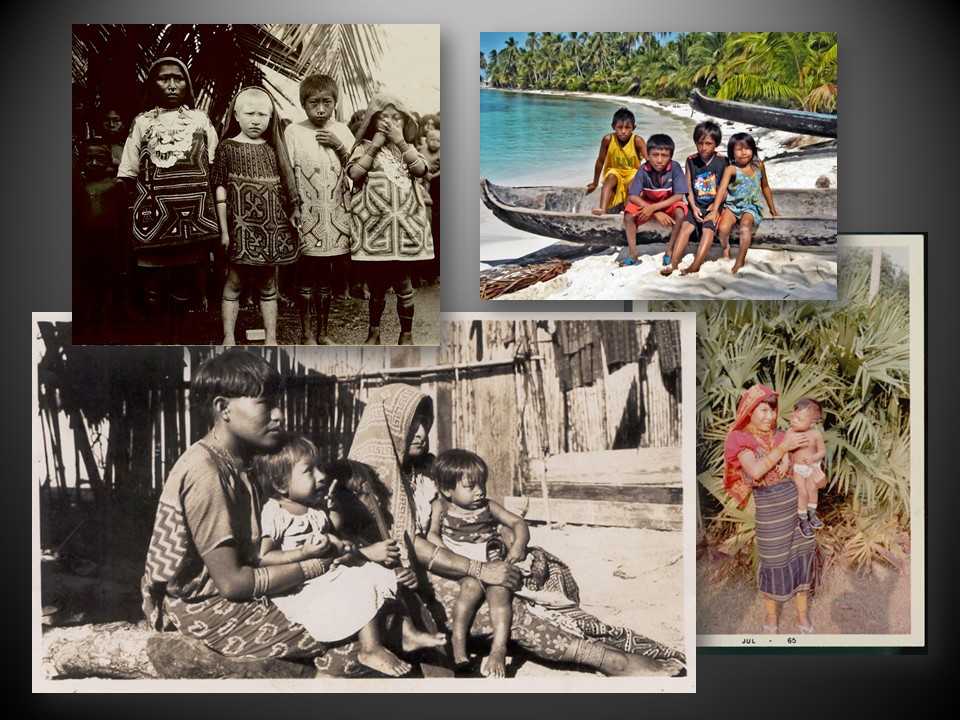
A treaty in the 1920s from the Panamanian government provided the Kunas with political and cultural autonomy following a Kuna revolt against governmental cultural suppression. The Kuna people are short in stature and have the highest rate of albinism in the world; the Kunas referred to them as “Moon Children” and have a legend that tells of a great serpent or jaguar that eats the face of the moon causing an eclipse. An albino or moon child must go out and shoot an arrow at the moon so that the spirit of the arrow will cause the beast to cough up the moon and prevent catastrophe of the natural order of things. 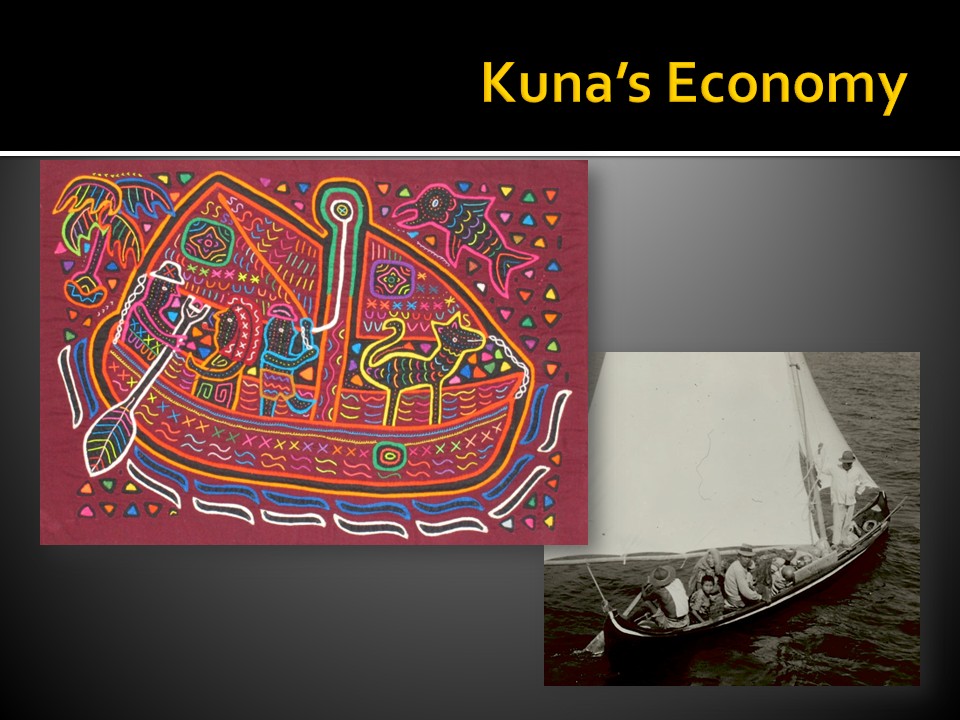
Kuna men travel in their tree trunk carved dugout canoes (called piraguas or cayucas) to the mainland to farm crops, hunt and to obtain fresh water. Coconuts and lobster are sold for income, along with molas to tourists on cruise ships or through mola cooperatives and other buyers. Some Kuna men leave Kuna Yala to work at jobs for wages in Panama City and Colon. 
The sale of molas accounts for an important source of income and economic survival for the Kuna and has resulted in improvements in the Kuna’s health care and educational systems. Molas are also traded or sold for needed domestic staples. 
Daily decisions regarding Kuna village political and social life are made at the congreso, or village meeting house. The Saila is the community political and spiritual leader. He sits in a hammock, chants stories and legends, and recites laws relating to the Kuna’s sacred history of his people while wearing a hat, a symbol of wisdom and clear thinking. 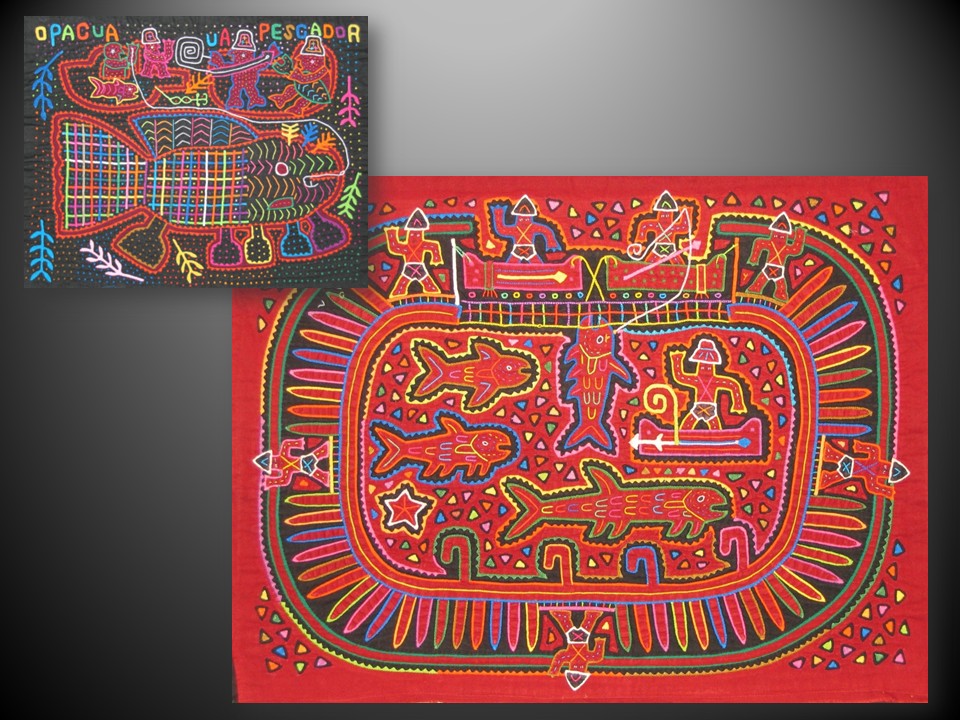
Daily decisions regarding Kuna village political and social life are made at the congreso, or village meeting house. The Saila is the community political and spiritual leader. He sits in a hammock, chants stories and legends, and recites laws relating to the Kuna’s sacred history of his people while wearing a hat, a symbol of wisdom and clear thinking. 
The wife’s responsibilities include providing care for her family, sewing molas and clothes, washing the family’s clothes, cleaning the house… 
The wife’s responsibilities include providing care for her family, sewing molas and clothes, washing the family’s clothes, cleaning the house… 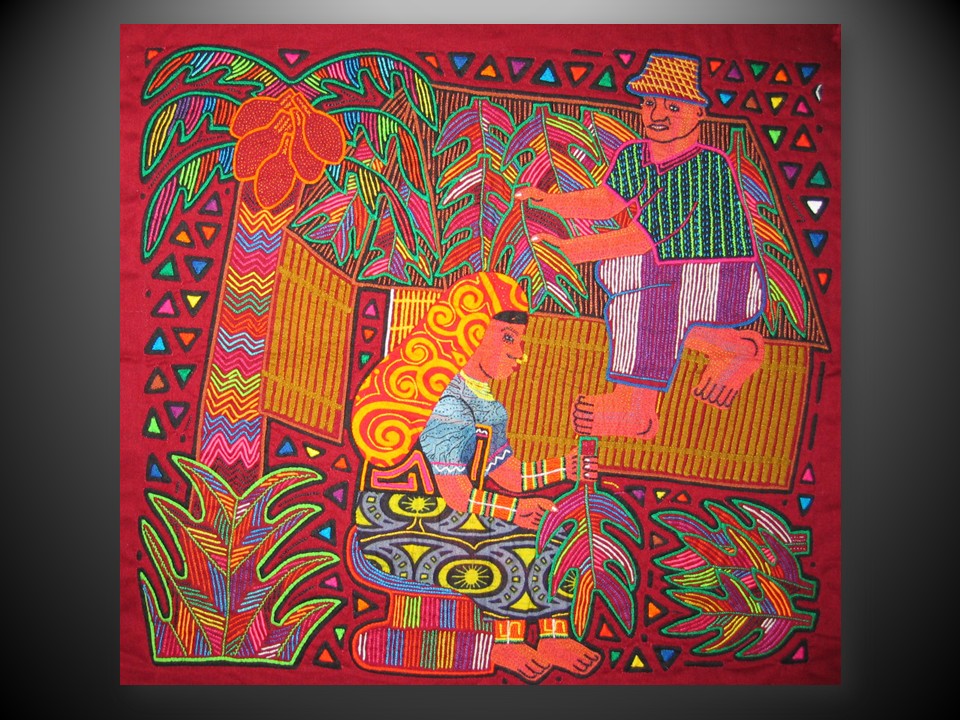
The Kuna live in thatched roof houses and believe that Ibeorgun taught their ancestors how to build their dwellings. Traditional houses were framed with massive tree trunks, roofed with dried palm fronds with walls of cane or bamboo. Kikadiryai taught the Kuna women ancestors how to make clothing from tree’s bark, thread from plants, scissors from wood, needles from thorns and mola designs and motifs. 
Through the visual and verbal arts given to the Kuna by their cultural heroes, they express their feelings of admiration and appreciation for their beautiful natural environment. 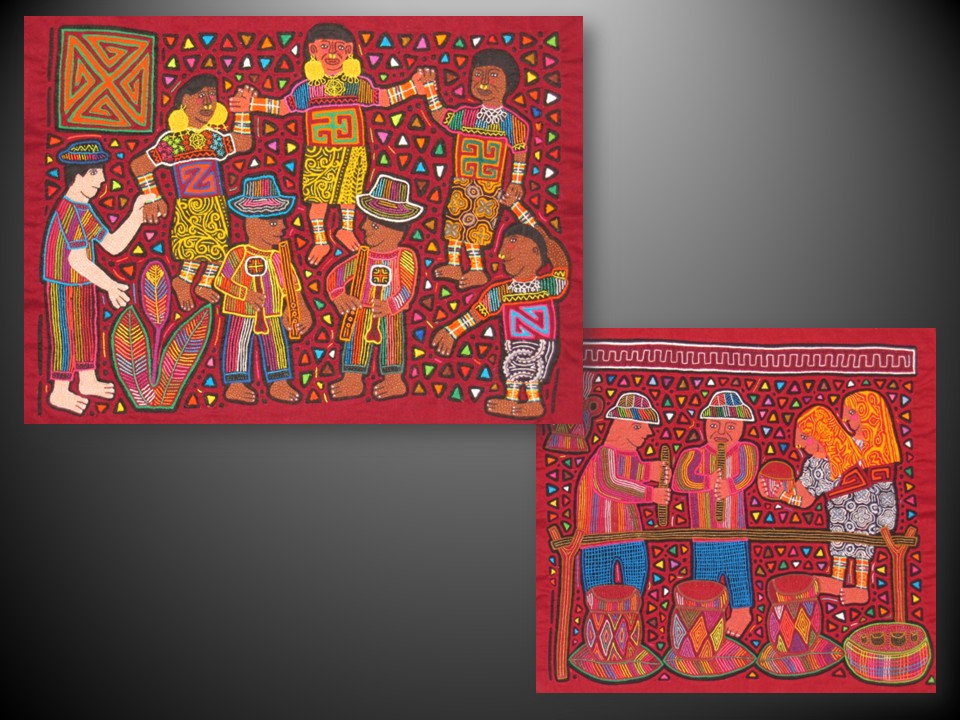
The Kuna people’s spoken language, “Tulekaya” only recently has begun to be written. Spanish is spoken in the educational system and for written documents. Some English is also spoken, due to the tourist industry in Panama and the American history in the Panama Canal Zone. Music is woven into songs and chants, celebrating all of life’s events. 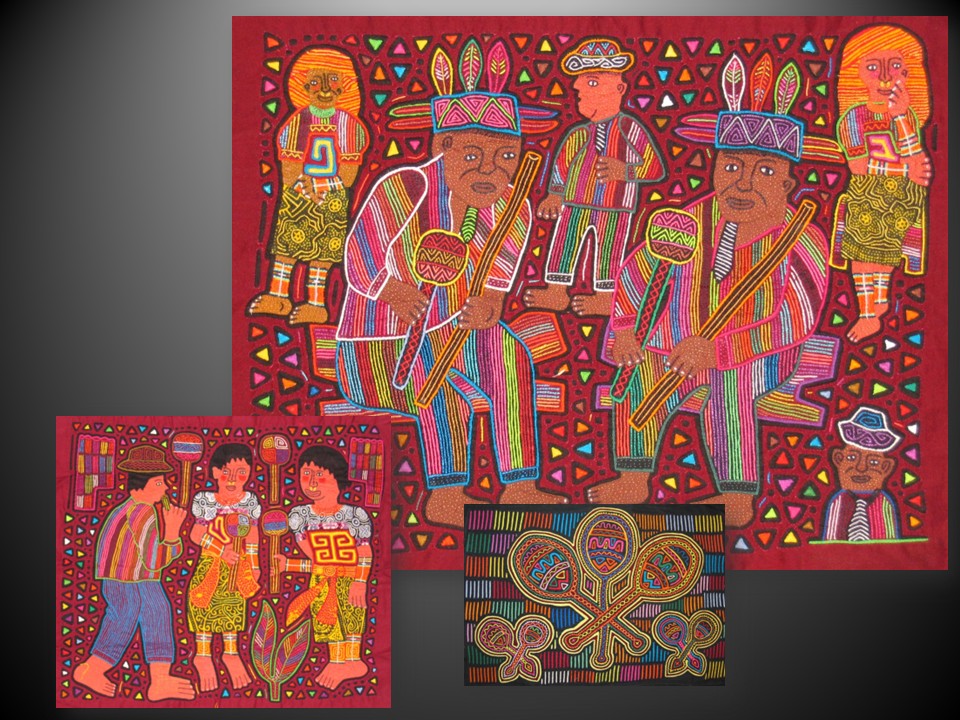
The bamboo panpipe flute and gourd rattles are accompanied by chants in various harmonies. The Kuna people combine verbal, visual and performance arts that express their values, thoughts and feelings. Verbal arts such as singing, chanting and political oratory are predominantly associated with men. The visual art of mola creation is associated with women, clothing their bodies and representing their traditions. 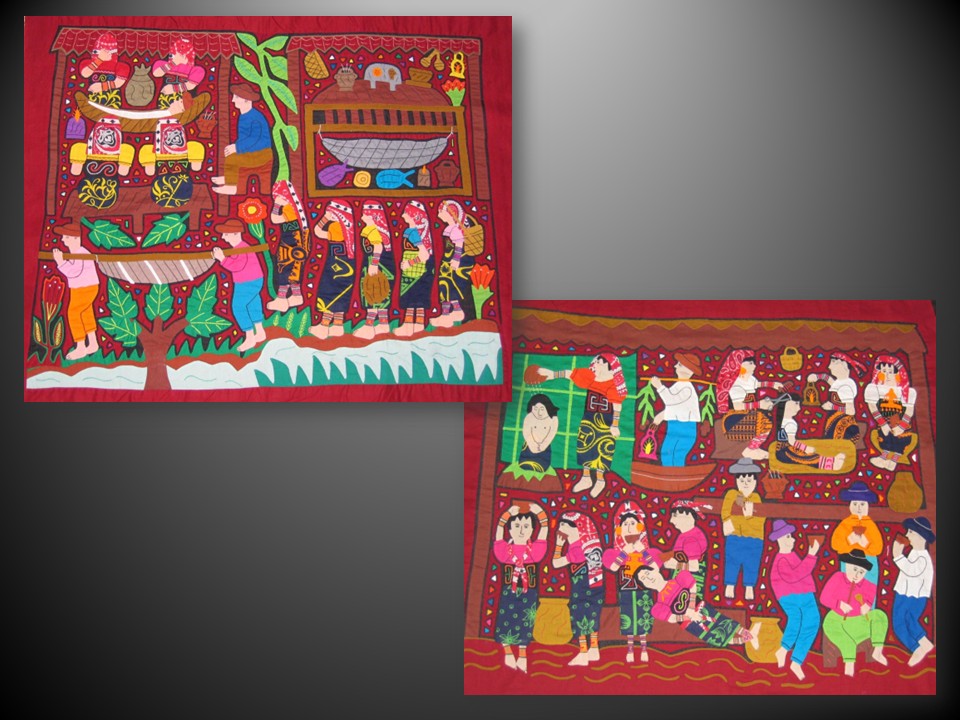
The Kuna have many culturally rich customs for the milestones of life – from birth, through maturity, marriage and death. Mola designs featuring traditional ritual themes and social activities may include a female’s coming-of-age ceremony, and celebratory festivities in the public gathering house. Customs are passed on and taught to children through dances and chants performed at many ceremonies where a potent locally brewed beverage, Chicha, is served. 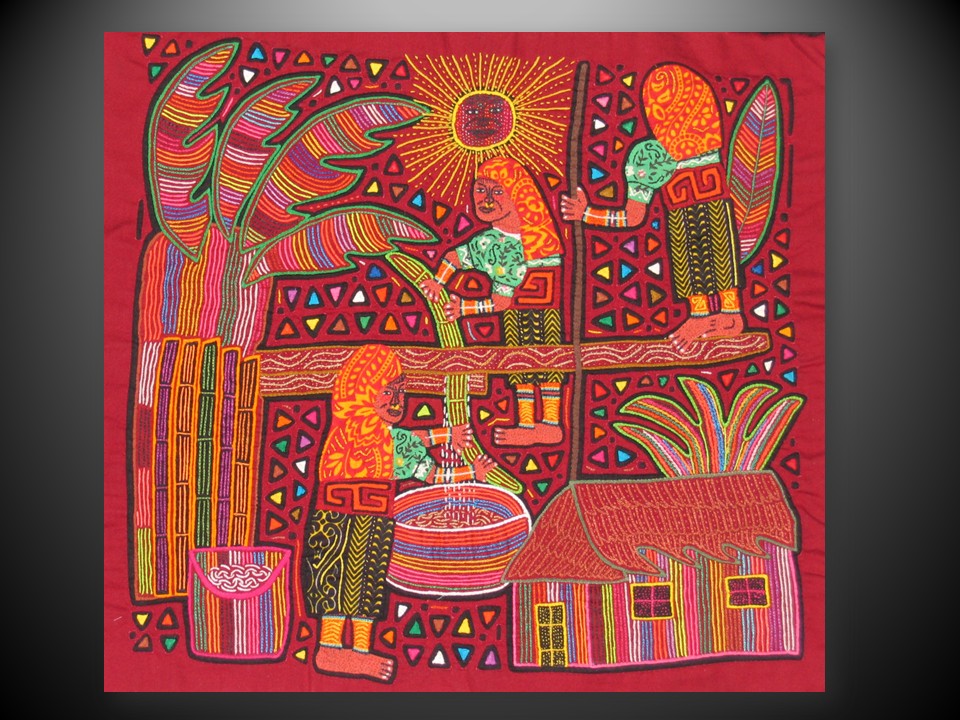
Chicha Fuerte is made of fermented sugarcane and other ingredients. This mola design depicts Kuna women squeezing the juice from stalks of sugarcane through a press. 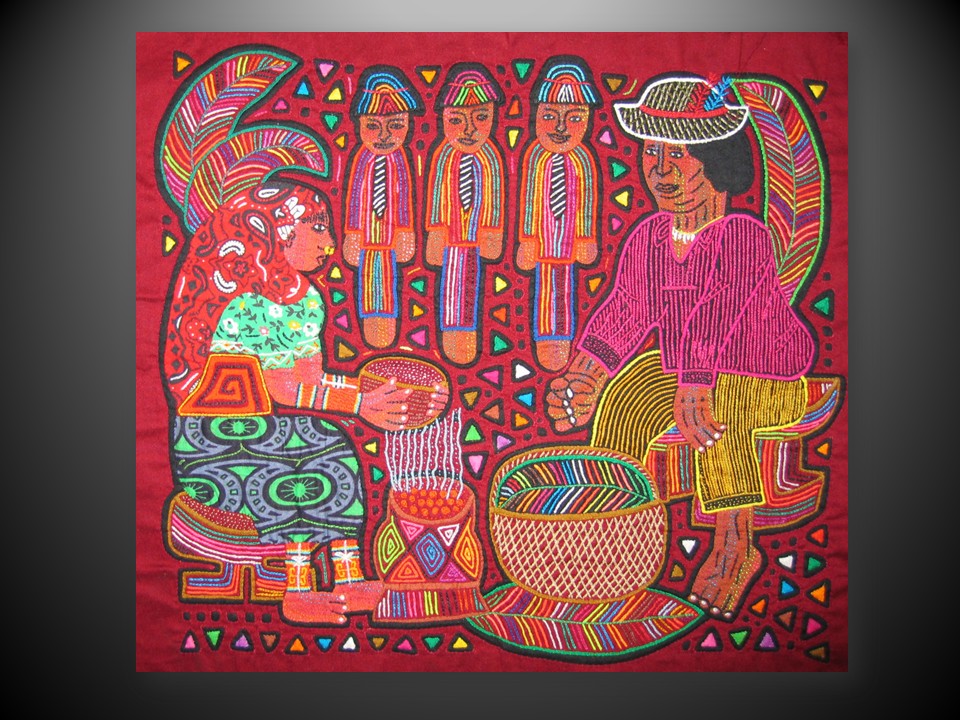
Spirit dolls called nuchu are carved by the Kuna and are used in healing, to ward off evil and for protection. Once carved, the nuchu is taken to a Kuna medicine man who fills it with a soul or spirit. 
Spirituality influences Kuna medicine with the medicine men (Nele) comprehending the forces at work during an illness, believing that mother earth must be in equilibrium for all to be well. If the spirits suggest, then the Nele will call on western doctors to intervene in an illness. 
Kuna women and men make, wear and use other handmade artifacts in their daily lives, for ceremonial purposes and to decorate their homes. Wooden dolls are carved, painted and dressed in miniature molas. Painted decorative gourds and maracas and flutes are made and played. They carve wooden boats, tools, arrows, toys, authority staffs and other functional implements and decorative items. Kuna men weave fire fans and baskets used for collecting fruits and vegetables and for storing molas. These handcrafted items may also be sold as a source of income. 
In addition to the mola textile art of the Kunas, Panama is home to several cultures with rich craft traditions. Here are several of the other indigenous arts of Panama paired with mola examples influenced by these art forms. 
The Wounaan and Emberá women create coiled baskets of extraordinary artistry using local plant fibers (upper left.) Chácara bags (lower left) are elaborately patterned string bags woven by the Ngöbe-Buglé or Guaymí of western Panama. The bags are woven from the fiber of the wild pineapple or agave plants and have many practical and decorative uses. Hand beaded Chaquira jewelry (upper right) was originally created for and worn by the warrior ancestors of the Ngöbe-Buglé. 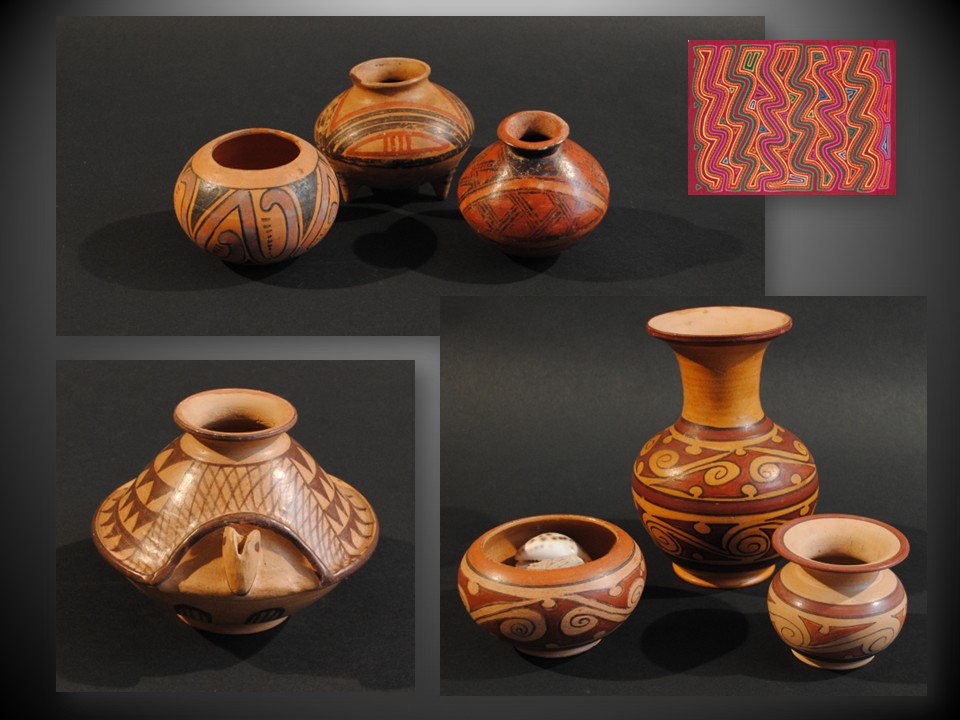
A long history of pottery making is found in La Arena on the Azuero Peninsula in southwestern Panama. The pre-Columbian clay pots and plates featured design motifs of native flora and fauna stylized into pictographs of extraordinary quality and beauty. In addition to the contemporary pottery featuring many of these designs… 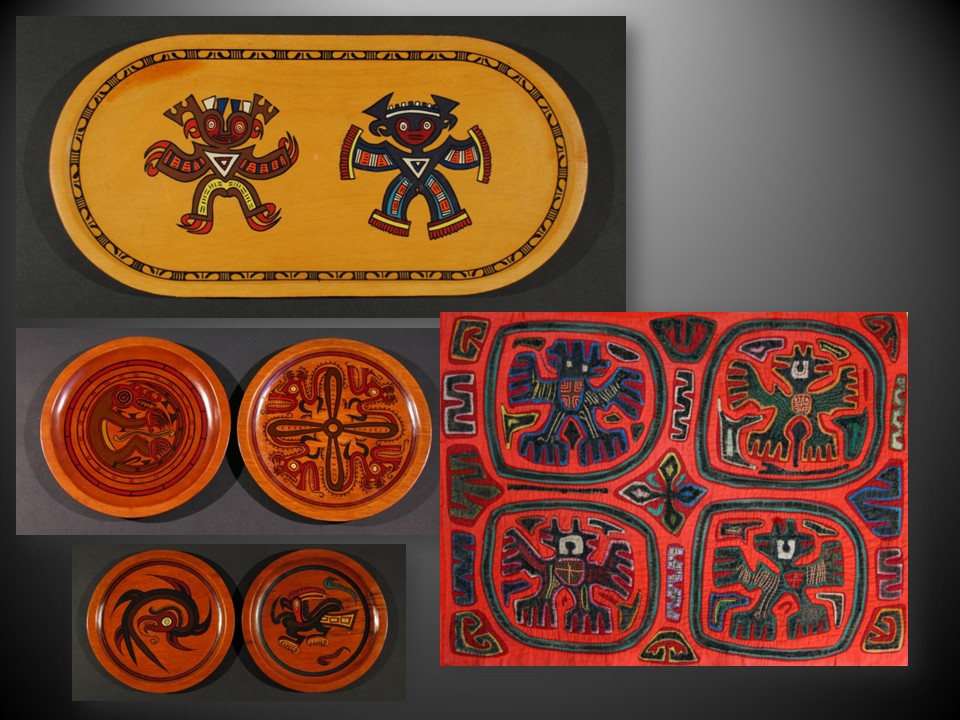
A long history of pottery making is found in La Arena on the Azuero Peninsula in southwestern Panama. The pre-Columbian clay pots and plates featured design motifs of native flora and fauna stylized into pictographs of extraordinary quality and beauty. In addition to the contemporary pottery featuring many of these designs… 
The arts of the pollera and montuno were born from Panama’s Spanish colonial historical era. The Pollera is Panama’s national costume and is a prized possession. Elaborate filigreed jewelry and combs in gold, encrusted with pearls, called mosqueta, are made in Panama and worn with the pollera costume, or as decorative jewelry. The beautiful painting in the background is by Al Sprague. 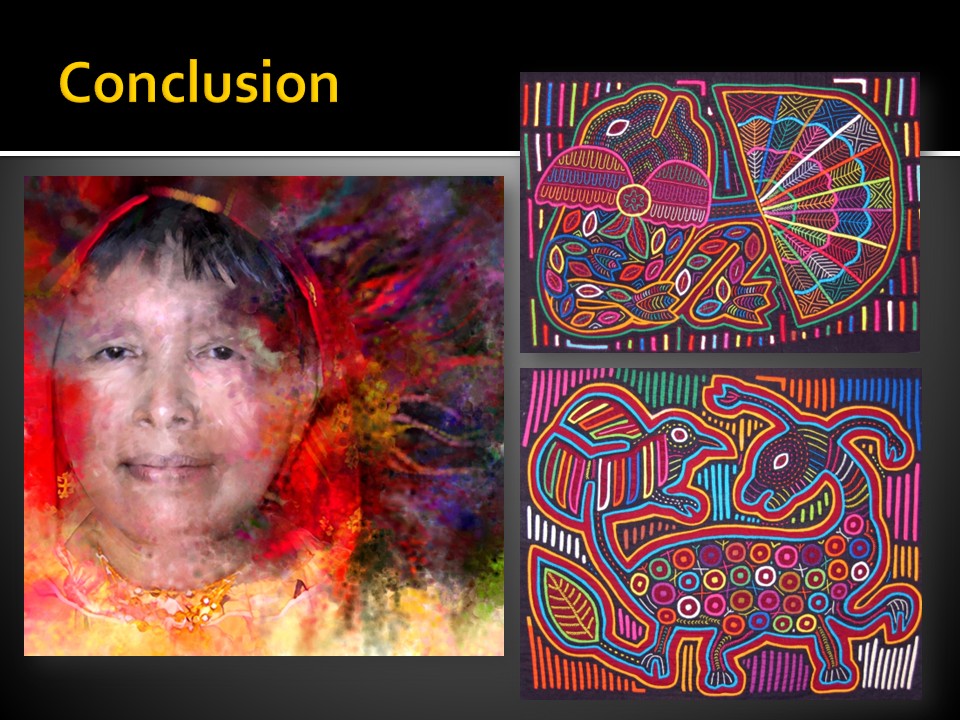
These two molas from the 1960s, the front and back of a dismantled mola blouse, may represent an eagle and golden frog huaca. Huacas were gold objects created by the ancient natives of Panama and were buried with their leaders and warriors. An eagle huaca symbolized power and authority; the frog represented life, health and good luck. These excellent molas of many colors, called Mor gonikat in the Kuna dialect, were created with complicated stitch work and space filling techniques and the harmonious use of color and compositional balance.
/

 Guna Molas