Ethnographic Summary of the Guna Indians of Panama (with Citations)
/

Introduction
The Guna Indians (also spelled Kuna or Dule) are an Indigenous people living primarily in Guna Yala, an autonomous Indigenous territory in northeastern Panama. They are known for their strong cultural identity, matrilineal social system, and autonomous governance, with an estimated population of 50,000–60,000 (Howe 2009; Sherzer 2010).
Geography and Environment
Guna Yala encompasses a narrow coastal strip and approximately 365 small coral islands. Only 50 or so are inhabited. The region faces environmental vulnerabilities, especially rising sea levels due to climate change (Díaz et al. 2017). Plans are underway to relocate some island communities to the mainland (Ramos 2016).
The marine and rainforest ecosystems support traditional livelihoods, including fishing, coconut harvesting, and subsistence agriculture (Chapin 2000).
History and Resistance
The Guna migrated to the San Blas region over centuries, partially due to Spanish colonization and conflict with neighboring groups (Howe 1986). In 1925, the Guna staged the Dule Revolution in response to Panamanian efforts at forced assimilation, including the banning of traditional customs (Howe 2009).
With U.S. mediation, the revolution led to a treaty recognizing Guna autonomy and laying the groundwork for the Comarca Guna Yala, officially established in 1938 (Howe 1998).
Social Organization
Matrilineality and Kinship
Guna society is matrilineal and matrilocal: property is passed through the female line, and men move into their wives’ homes upon marriage (Sherzer 2010). Extended families form economic and ritual units, reinforcing lineage ties (Chapin 2000).

Two Kuna women sewing molas, Kuna Yala, Panama, c. 1975. Photograph by the Edith Crouch.
Gender and Complementarity
Gender roles are based on complementarity rather than strict hierarchy. Women control land and are central to household and economic life, especially through mola production (Smith 1995). Men typically engage in public political life and farming.
The Guna recognize gender diversity, including omeggid (individuals assigned male at birth who adopt traditionally feminine roles), who occupy unique ritual and social positions (Hernández & López 2018).
Political Organization
The Guna have developed a model of Indigenous self-governance centered around the congreso—village-wide meetings held in a communal house where decisions are made by consensus (Howe 2009).
Each community is led by a Saila, a singer-leader who performs ritual speech and interprets oral law. The General Guna Congress coordinates inter-village matters and interactions with the Panamanian state and external organizations (Howe 1998; Sherzer 2010).
Economy and Livelihood
Subsistence and Trade
Guna households rely on a mixed economy:
- Fishing, agriculture, and coconut trade provide subsistence.
- Coconuts once served as currency and are still a core economic and cultural product (Chapin 2000).
- Molas, elaborately stitched textile panels, are sold locally and internationally (Smith 1995).
Tourism and Autonomy
Tourism, especially community-based ecotourism, is tightly controlled by Guna institutions. They restrict foreign hotel chains and impose cultural protocols to protect their territory and values (Howe 2009).
Cosmology and Religion
Guna cosmology centers around a multi-layered universe created by Papa Olokun and guided by cultural heroes like Ibeorgun. Spiritual beings such as Muu and Nuchu mediate between humans and the spiritual world (Sherzer 1990; Salvador 2000).
Neles (female shamans) and ikinis (male healers) diagnose illness as imbalances between the spiritual and material realms. Healing involves ritual songs, spirit consultations, and herbal remedies (Salvador 2000).
Christianity (Catholic and Evangelical) coexists with traditional beliefs, although tensions have grown in some communities due to evangelical rejection of Indigenous ritual practices (Howe 1998).
Ritual and Life-Cycle Events
Puberty and Gender Rites
Puberty ceremonies for girls (inna suid) are among the most elaborate rituals. Upon menarche, girls are secluded, symbolically bathed, and celebrated through music, dance, and public feasting (Chapin 2000).
Other Rituals
Rites of passage such as naming, weddings, and funerals are deeply ceremonial and involve the recitation of sacred songs and community-wide participation (Sherzer 1990). Chicha fuerte (fermented maize drink) is ritually consumed in many of these events, marking liminality and communal bonding.
Art and Material Culture

The mola, developed in the 19th century, evolved from body painting traditions into textile appliqué. Each mola can take weeks to complete and is often worn as part of a woman’s blouse (Smith 1995). Common themes include animals, myths, and modern global symbols—an expression of visual sovereignty (Tice 1995).
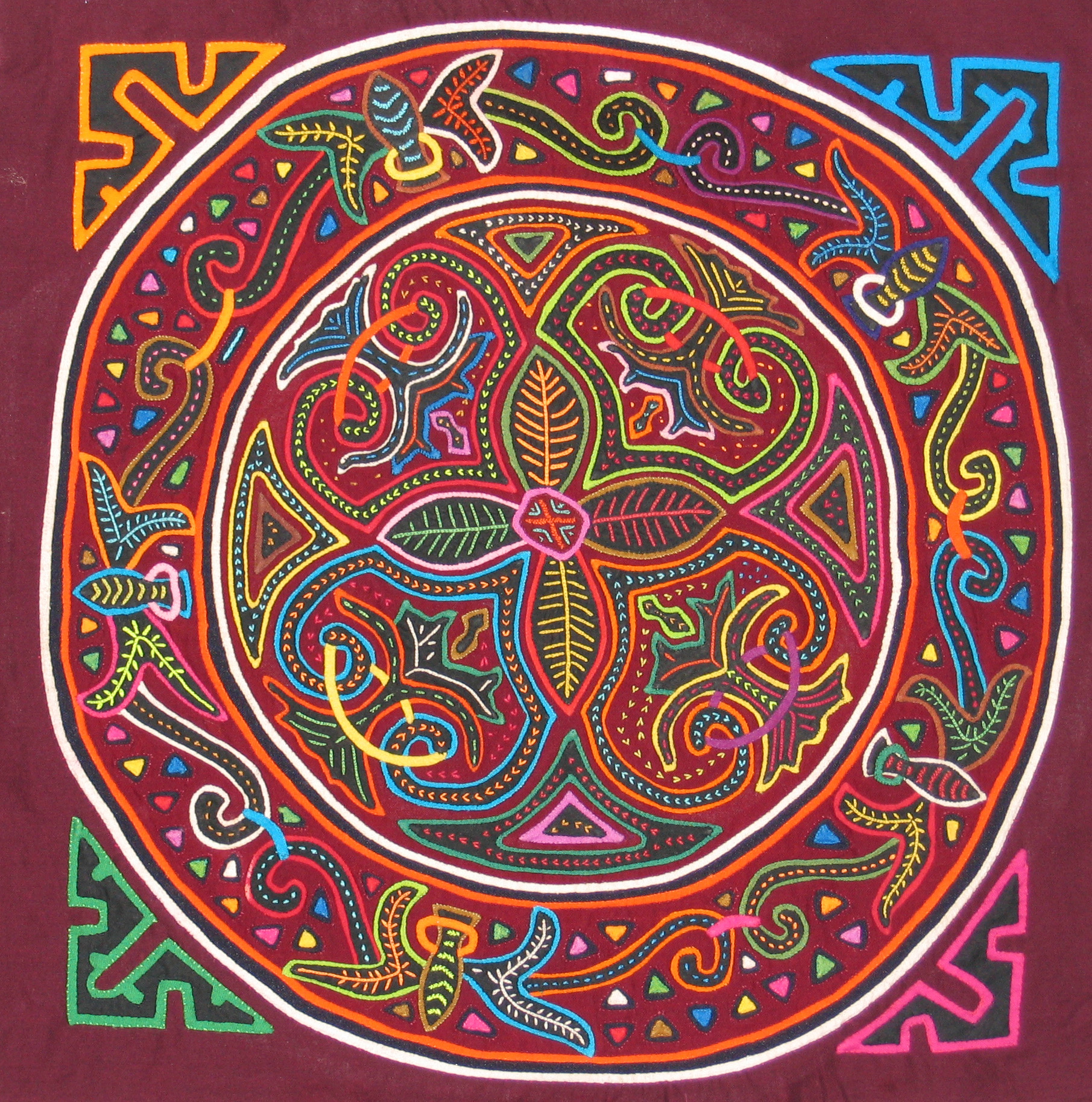
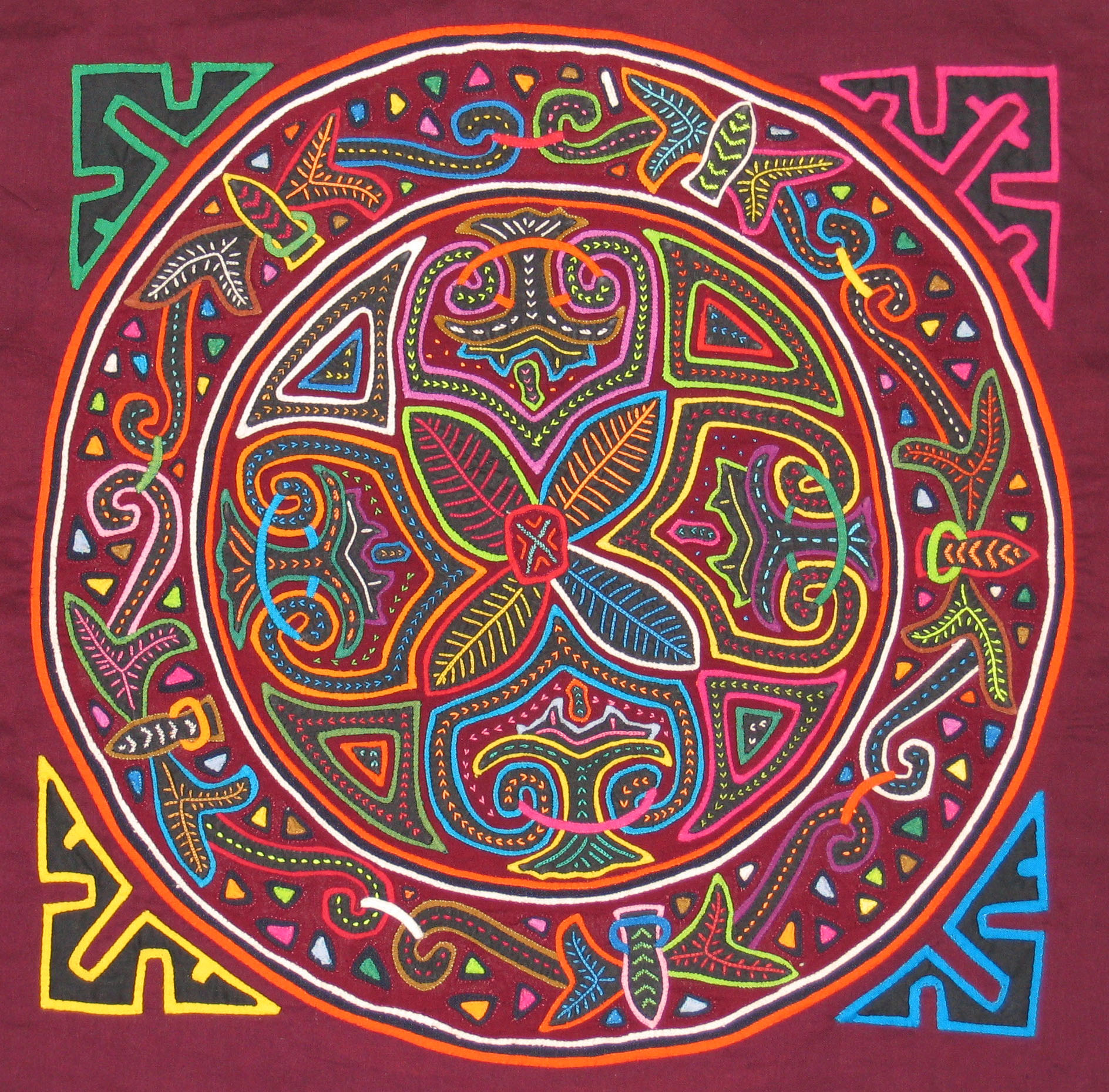
Interconnected floral motifs encircle a central flower design in these companion molas that also resemble batea designs, c. 2005. Copyrighted photograph by and courtesy of Sue Murray “Molagirl” Gomez.
Other forms of art include carved wooden figures (nuchu), jewelry, and beadwork, with designs often drawing from cosmological or mythic motifs (Sherzer 2010).
Language and Oral Tradition
The Guna speak Dulegaya, a Chibchan language with several dialects. Despite pressures from Spanish, Dulegaya remains widely spoken, particularly in ritual and public domains (Sherzer 2010).
Ceremonial speech, especially the poetic form called pap soge, is used by sailas in the congreso. This form of speech encodes oral law, cosmology, and moral instruction (Sherzer 1990).
Efforts in bilingual education and language revitalization are ongoing, with materials produced in Dulegaya and community-run schools promoting cultural literacy (Howe 2009).
Education and Modern Challenges
Intercultural Education
The Guna have implemented intercultural bilingual education programs aimed at reinforcing Indigenous knowledge systems while ensuring national curriculum requirements (Ramos 2016).
Contemporary Issues
Guna communities face several modern challenges:
- Climate change and sea level rise threaten low-lying island communities (Díaz et al. 2017).
- Youth migration to urban centers has increased, raising concerns about cultural continuity.
- Evangelical conversion sometimes conflicts with traditional rituals and authority structures (Howe 1998).
- Tourism pressure risks commodifying Guna culture if not carefully managed (Chapin 2000).
Despite these pressures, the Guna have maintained robust political institutions and cultural practices, leveraging both traditional knowledge and modern legal frameworks to protect their autonomy.
Conclusion
The Guna people of Panama offer a compelling example of how Indigenous communities can maintain cultural integrity, matrilineal social systems, and ecological balance through adaptive governance, ritual practice, and strategic resistance. Through decades of political struggle and cultural creativity, they continue to assert their place in both national and global conversations about Indigenous rights, environmental stewardship, and cultural heritage.
References
- Chapin, Mac. A Challenge to Conservationists. World Watch Magazine, 2000.
- Díaz, H., et al. “Climate Change and Indigenous Peoples in Latin America.” Inter-American Development Bank, 2017.
- Hernández, É., & López, M. (2018). “Gender and Sexual Diversity among the Kuna People.” Anthropological Notebooks 24(1): 45–62.
- Howe, James. The Kuna Gathering: Contemporary Village Politics in Panama. University of Texas Press, 1986.
- Howe, James. A People Who Would Not Kneel: Panama, the United States, and the San Blas Kuna. Smithsonian Institution Press, 1998.
- Howe, James. Chiefs, Scribes, and Ethnographers: Kuna Culture from Inside and Out. University of Texas Press, 2009.
- Ramos, Alcida. “Indigenous Relocation and Climate Change in Panama.” Latin American and Caribbean Ethnic Studies, 2016.
- Salvador, Mariella. Healing and Cosmology in Kuna Society. PhD Dissertation, University of Oregon, 2000.
- Sherzer, Joel. Kuna Ways of Speaking: An Ethnographic Perspective. University of Texas Press, 1990.
- Sherzer, Joel. Speech Play and Verbal Art among the Kuna. Cambridge University Press, 2010.
- Smith, C. Zoe. “The Art of Being Kuna: Layers of Meaning Among the Kuna of Panama.” In Textile Traditions of Mesoamerica and the Andes, 1995.
- Tice, Karin E. Kuna Crafts, Gender, and the Global Economy. University of Texas Press, 1995.
Ethnographic summary created with the assistance of ChatGPT
/


 Guna Molas